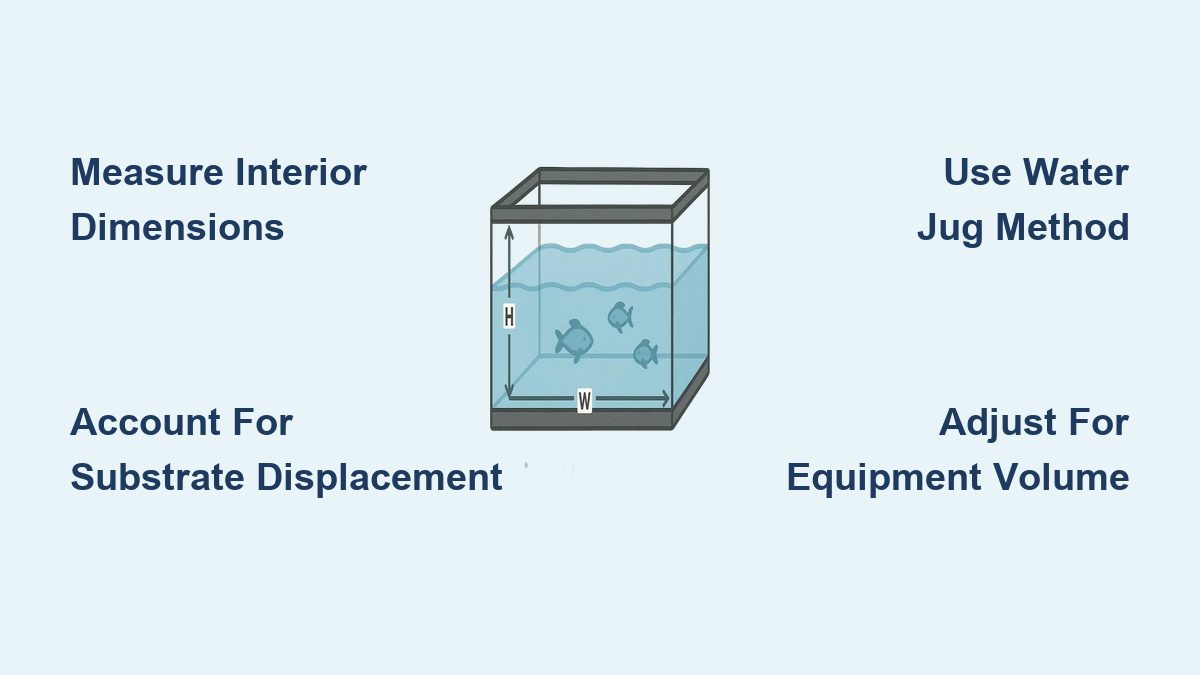
How to Calculate Aquarium Gallons
Your “20-gallon tank” likely holds only 17 gallons of actual water. This discrepancy causes dangerous overdosing of medications, incorrect fish stocking, and undersized equipment—silent killers in aquariums. When you misjudge your tank’s true water volume, you gamble with the lives of your fish. This guide reveals exactly how to compute gallons in aquarium setups of any shape, accounting for displacement from substrate and decor. You’ll learn industry-proven measurement techniques that ensure precise dosing, proper filtration, and a thriving aquatic ecosystem—no guesswork required.
Most beginners rely on the tank’s advertised size, but glass thickness, substrate depth, and hardscape consume significant space. A standard 55-gallon tank might hold just 47 gallons of usable water after accounting for these factors. Under-dosing medications becomes ineffective, while over-dosing can wipe out entire communities overnight. By mastering these calculation methods, you’ll gain control over water parameters, prevent equipment failures, and create stable environments where fish flourish. Let’s transform uncertainty into precision.
Why Your Tank Holds Less Water Than the Label Claims
Aquarium manufacturers advertise capacity based on exterior dimensions, ignoring critical real-world factors. Glass thickness alone reduces volume—a 10-gallon tank’s 1/4-inch glass walls consume nearly 1.5 gallons of space. But the bigger issue is displacement from essential elements you add after setup. Your substrate layer alone can eliminate 10-15% of water volume; a 3-inch sand bed in a 75-gallon tank displaces over 7 gallons. Large rocks, driftwood, and internal filters further shrink usable space.
Critical displacement culprits:
– Substrate: 2 inches of gravel reduces volume by 8-12%
– Hardscape: A single 10-pound rock displaces ~1.5 gallons
– Equipment: Internal filters and heaters claim 0.5-2 gallons
– Water level: Leaving 1.5 inches below the rim sacrifices 3-5% capacity
Never fill to the brim—this prevents fish jumps and accommodates filter outflow. The “55-gallon” tank you bought? Its true capacity is likely 45-48 gallons before adding anything. This is why learning how to compute gallons in aquarium environments is non-negotiable for responsible fishkeeping.
Rectangular Tank Calculation: Measure Interior Dimensions Only
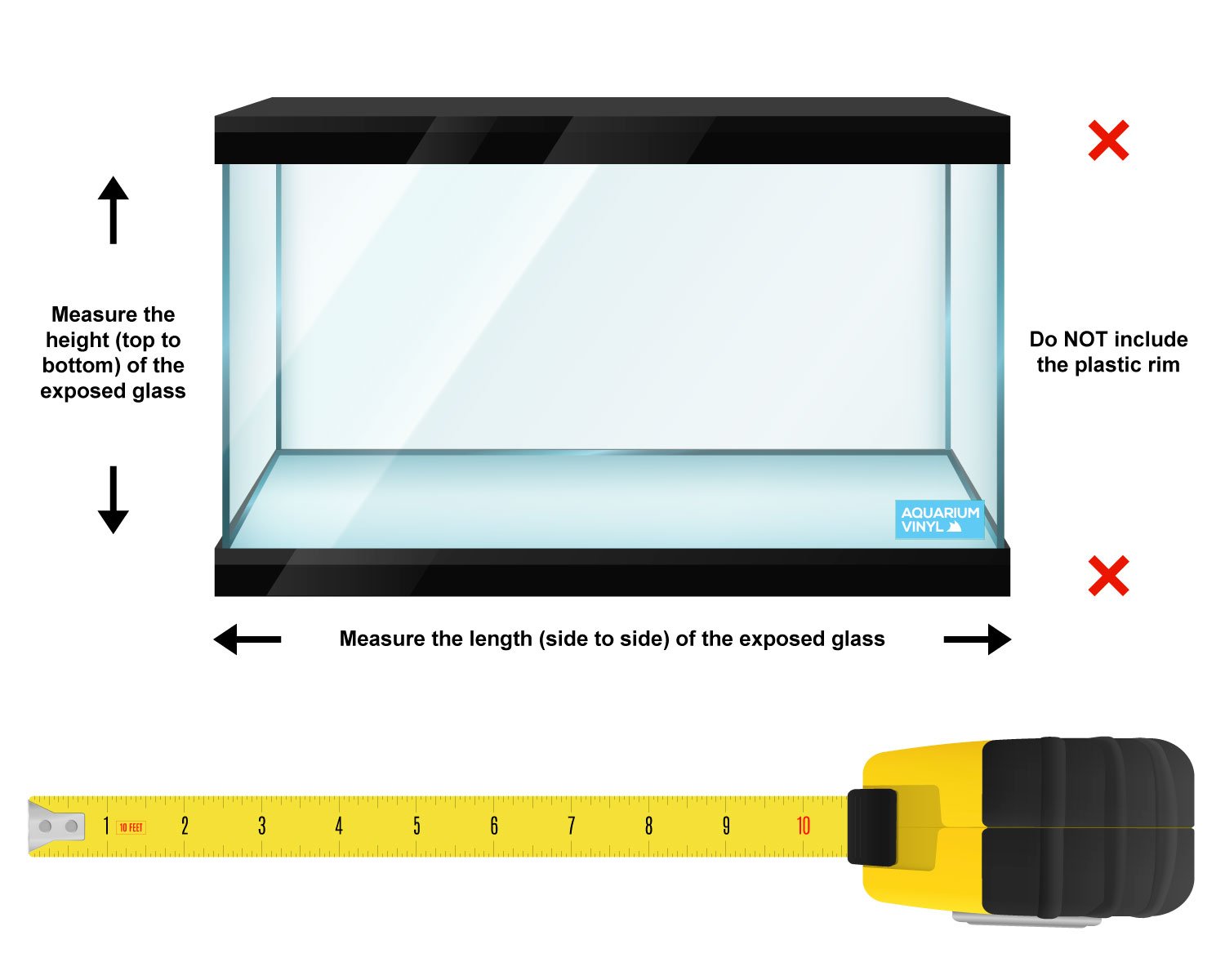
Stop using the tank’s advertised size—it’s dangerously inaccurate. Grab a tape measure and record the inside dimensions where water actually sits. Place the tape against the inner glass, not the outer frame. Measure length from left to right, width front to back, and height from the bottom glass to your typical water line (usually 1-2 inches below the rim).
Apply this precise formula:
Gallons = (Length × Width × Height) ÷ 231
(All measurements in inches; 231 = cubic inches per US gallon)
Real-world example for a “29-gallon” tank:
– Advertised size: 29 gallons
– Actual interior dimensions: 30″ L × 12″ W × 18″ H
– Calculation: (30 × 12 × 18) = 6,480 ÷ 231 = 28.05 gallons
– After displacement: Subtract 15% for substrate/hardscape = 23.8 gallons
Pro tip: Double-check height at multiple points—uneven stands cause slanted water lines. If measurements vary, use the lowest height value. Always measure in inches; metric conversions introduce errors. This method works for cubes, breeder tanks, and standard rectangles.
Why Your Initial Calculation Is Still Too High
Your raw formula result assumes an empty tank filled to the absolute top. Reality differs:
– Substrate compression: Sand settles deeper over time, increasing displacement
– Equipment placement: Filter intakes submerged below substrate level
– Water surface tension: Creates a slight “dome” above the rim, but never rely on this
For medication dosing, always subtract 10-20% from your calculated volume. In the 29-gallon example above, using 28 gallons instead of 23.8 could overdose fish by 18%.
Non-Rectangular Tank Calculations: Cylinders and Bow Fronts
Cylindrical Tanks: Radius Is Key to Accuracy
Measuring drum tanks or round aquariums requires finding the radius (half the diameter). Never use diameter directly—this is the #1 error causing 300% overestimates. For a 24-inch diameter tank:
1. Measure inner diameter at water level (e.g., 23.5″)
2. Calculate radius: 23.5″ ÷ 2 = 11.75″
3. Square the radius: 11.75 × 11.75 = 138.06
4. Apply formula: (3.14 × 138.06 × height) ÷ 231
Example for 24″ diameter × 20″ height tank:
(3.14 × 138.06 × 20) = 8,668.6 ÷ 231 = 37.5 gallons
After displacement: Subtract 15% = 31.9 gallons
Bow Front Tanks: Avoid Guesswork With This Method
The curved front makes manual calculations unreliable. Do not treat it as a rectangle—this overestimates by 12-18%. Instead:
1. Measure as a rectangle using max interior width/length
2. Multiply by 0.85 (15% reduction for curvature)
3. Then subtract displacement for substrate/decor
For a “75-gallon bow front” (48.5″ L × 18.75″ W × 21″ H):
– Rectangular calc: (48.5 × 18.75 × 21) ÷ 231 = 82.7 gallons
– Apply curvature adjustment: 82.7 × 0.85 = 70.3 gallons
– Subtract 15% displacement: 59.8 gallons
Critical warning: Online calculators often ignore curvature. Verify any digital tool’s formula includes a 12-18% reduction factor for bow fronts.
The Water Jug Method: Most Accurate Volume Measurement

When precision is critical—like during disease treatment—this technique beats all formulas. It accounts for your specific substrate depth, rock placement, and water level. Complete this in 15 minutes before adding fish:
- Place empty tank on leveled stand
- Position a 1-gallon pitcher (or 5-gallon bucket) nearby
- Fill pitcher to the brim and pour into tank
- Count each full pitcher until water reaches 1-1.5″ below rim
- For partial fills: Use measuring cups (16 cups = 1 gallon)
Why this works: It measures actual usable water, including displacement from your unique setup. A 55-gallon tank with 4″ sand and lava rock typically takes only 46-48 gallons to fill—exactly what you need for dosing. Record this number permanently inside your cabinet.
Pro tip: For established tanks, siphon water into clean containers during maintenance. Mark levels on buckets for future water changes—knowing your true volume prevents parameter swings.
5 Costly Calculation Mistakes That Harm Fish
:strip_icc()/SPR_1380694-aquarium-sizes-and-weights-1bf7f0fbbfd44d6caca00657f70a33d3.png)
Mistake #1: Using Exterior Dimensions
Consequence: 5-10% overestimation → lethal medication doses
Fix: Press tape measure against inner glass; subtract 0.5″ per side for standard tanks
Mistake #2: Ignoring Substrate Depth
Consequence: 15%+ volume error with deep sand beds
Fix: Calculate displacement: (Tank length × width × sand depth) ÷ 231 = displaced gallons
Mistake #3: Forgetting Equipment Displacement
Consequence: Heater undersizing causing temperature crashes
Fix: Add 0.75 gallons to displacement for every 10 lbs of hardscape
Mistake #4: Trusting “Gallon” Labels for Odd Shapes
Consequence: Filter under-cycling leading to ammonia spikes
Fix: For hexagons or cylinders, always use the jug method
Mistake #5: Not Re-measuring After Decor Changes
Consequence: Sudden bioload imbalances during aquascaping
Fix: Re-calculate volume after adding >5 lbs of new hardscape
Why Accurate Gallon Calculation Saves Your Aquarium
Medication dosing: A 50% overdose of antibiotics kills beneficial bacteria. If your 40-gallon tank actually holds 34 gallons, using 40-gallon dosing delivers 18% excess concentration.
Filter sizing: Filters are rated by actual GPH (gallons per hour). A 300 GPH filter is inadequate for a 55-gallon tank holding 47 gallons (needs 4-6x turnover = 188-282 GPH). Under-filtering causes nitrate buildup.
Heater selection: The standard 5 watts/gallon rule fails with inaccurate volumes. A 55-gallon tank at 47 gallons requires 235 watts—not the 275 watts for 55 gallons. Undersized heaters cause lethal cold snaps.
Water changes: Changing “25%” of a misjudged tank creates parameter shock. If you think you have 30 gallons but actually have 25, removing 7.5 gallons (25% of 30) removes 30% of your water—disrupting the nitrogen cycle.
Maintain Precision With These Pro Habits
Create a volume log: Record true gallons after each major change (substrate depth, new hardscape). Note: “75-gallon bow front: 62.3 gal after 3″ sand + 20 lbs dragon stone.”
Re-measure seasonally: Substrate compacts over time; recheck every 6 months using the jug method during maintenance.
Label equipment: Write your actual gallon count on filter/heater boxes: “Use for 48-gallon system (true volume).”
Verify online calculators: Input known rectangular tank dimensions—if it doesn’t match manual calculations, discard the tool.
For medication emergencies: Always use the jug method. When fish are sick, guesswork isn’t an option.
Computing gallons in aquarium systems isn’t just math—it’s the foundation of responsible fishkeeping. By measuring interior dimensions, accounting for displacement, and verifying with the water jug method, you transform guesswork into precision. This single skill prevents overdosing disasters, ensures equipment efficiency, and creates stable environments where fish thrive. Your true water volume is the compass for every critical decision in aquarium care. Master it, record it, and reference it before every dose, stock, or equipment change—your fish’s survival depends on it.