How to Use CO2 Tablets in Aquarium: Easy Guide
You’ve just set up a 5-gallon low-tech aquarium with a betta and some easy plants like anubias. Hoping for lusher growth, you grab a bottle of CO2 tablets only to discover—no dosing instructions. You’re not alone. Countless hobbyists face this exact dilemma, lured by the promise of a “simple CO2 boost” but left guessing how to actually use these tablets safely. The harsh reality? Many experienced aquarists report these tablets deliver inconsistent results at best, and outright tank disasters at worst. After analyzing real user experiences from nano tank owners, we’ve distilled exactly how to dose, monitor, and avoid pitfalls—so you can decide if tablets are right for your specific setup.
Here’s what you won’t find on the bottle: CO2 tablets often fail to measurably increase dissolved CO2 levels, can spike water hardness, and risk lethal overdoses for sensitive livestock. But if you’re determined to try them (perhaps as a temporary fix before moving or for a very small tank), this guide cuts through the confusion with actionable steps verified by actual users. You’ll learn precise dosing strategies for your tank size, critical safety checks to run before adding each tablet, and when to ditch tablets entirely for better alternatives.
Determining Your Exact CO2 Tablet Dosage by Tank Size
Getting the dose wrong is the fastest path to algae explosions or dead shrimp. Forget generic “1 tablet per tank” advice—your gallon capacity, plant types, and light intensity dictate everything. Start absurdly low and adjust only after 3–5 days of observation.
How Many Tablets for 5-Gallon Tanks (The Most Common Setup)
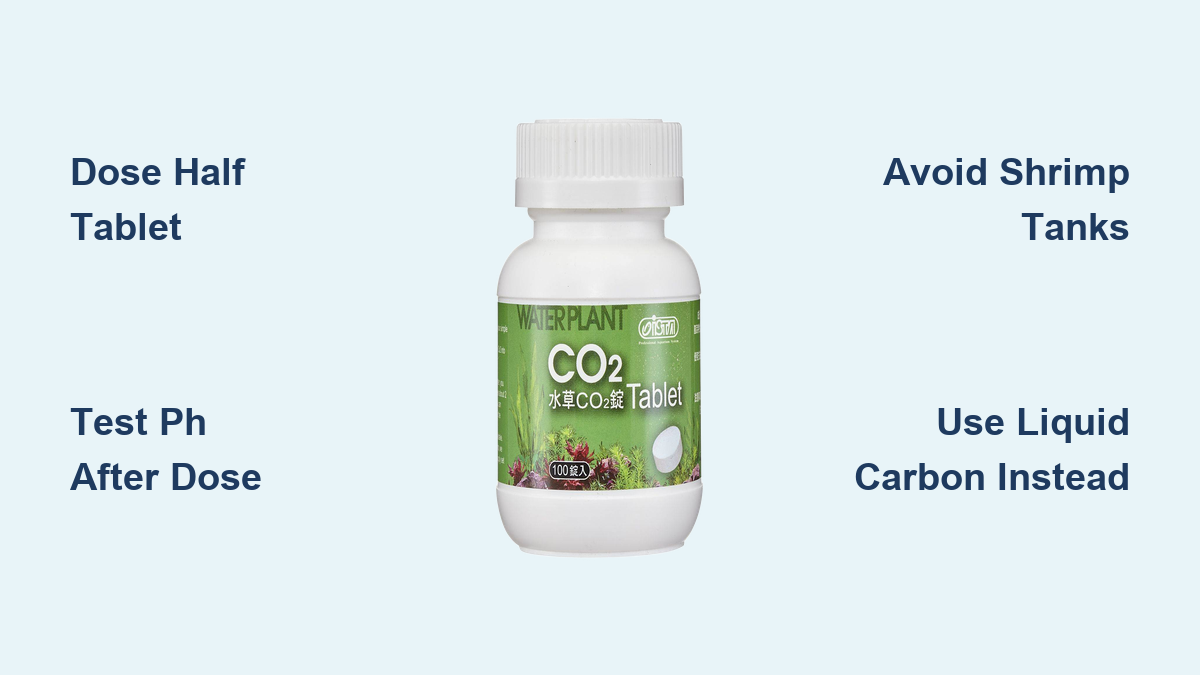
For nano tanks under 10 gallons, begin with half a tablet every other day—even if the bottle suggests otherwise. One 5-gallon tank owner successfully used one full tablet daily for their betta and snails with no issues, but only after confirming stable pH readings. Crucially, if you keep shrimp (like crystal reds), halve that dose: a single overdose reportedly wiped out an entire shrimp colony. Always crush tablets to control portions—never guess.
Scaling Up for 10+ Gallon Tanks: When Tablets Become Impractical
In larger setups, CO2 tablets quickly lose cost-effectiveness and precision. A 12-gallon long tank owner doses three tablets daily (one at lights-on, one midday, one before lights-off), but this requires constant pH monitoring. For tanks over 10 gallons, most experienced users agree: tablets deliver unstable CO2 spikes that plants barely utilize before the gas outgasses. As one tester bluntly stated, “They don’t do anything. Possibly do more harm than good.” If your tank exceeds 10 gallons or houses high-light plants (like stem varieties), skip tablets entirely—they’ll waste money while risking water chemistry chaos.
Matching Dosing to Your Light Schedule: The Non-Negotiable Rule
Your lights dictate CO2 needs. Only dose when lights are ON—plants absorb CO2 during photosynthesis, not at night. Dosing after lights-off starves plants while suffocating fish as CO2 accumulates in oxygen-depleted water. Time doses to your photoperiod: add the first tablet the moment lights turn on, then a second dose only if >4 hours of light remain (as one user confirmed: “dose again when you turn on aquarium lights… if 4 hours of light left”). Low-light tanks? You likely don’t need CO2 at all—many warn it’s “a waste of energy” for easy plants like java fern.
Step-by-Step Tablet Dosing Protocol for Immediate Safety

Follow this sequence religiously to prevent crashes. One misstep can trigger pH drops that stress fish or cause algae blooms.
Where and How to Place Tablets for Even Distribution
Drop tablets near filter outflow or powerhead streams—never directly on substrate. Water flow disperses CO2 gradually, avoiding deadly “hot spots” where fish might linger. Avoid placing tablets near shrimp caves or betta resting zones; weak currents there concentrate CO2. For 5-gallon tanks, position tablets midway between filter output and plants. If your tank lacks strong flow, manually stir the water for 30 seconds after adding a tablet to prevent localized saturation.
Mandatory Water Checks After Every Dose
Test pH and KH within 1 hour of adding a tablet, especially during your first week. CO2 dissolves into carbonic acid, causing temporary pH dips. One user mitigated this by “adding more driftwood to balance it out,” but this isn’t foolproof. If pH drops >0.4 units below your baseline, perform a 25% water change immediately. Also track GH weekly—tablets often raise hardness due to binding agents, which can kill shrimp. If GH climbs steadily, discontinue tablets; no amount of water changes will reverse mineral buildup long-term.
Recognizing Overdose Symptoms Before It’s Too Late
Fish gasping at the surface or erratic darting means CO2 is lethal right now. Turn off filters (to maximize oxygen exchange), perform a 50% water change, and skip all future doses. Snails retracting into shells or shrimp becoming lethargic are early warnings. One user’s “entire shrimp colony” died because they ignored subtle signs. If you see green water or sudden hair algae, it’s a red flag: excess CO2 without sufficient plant mass creates nutrient imbalances. Stop dosing for 7 days and prune algae aggressively.
Critical Risks Most Guides Ignore (Backed by User Disasters)
CO2 tablets aren’t just “meh”—they actively destabilize tanks in ways beginners never anticipate. These risks are non-negotiable for sensitive ecosystems.
Why Tablets Fail to Boost Plant Growth Like Pressurized Systems
Tablets create short-lived CO2 spikes that outgas before plants absorb them. Multiple user tests confirm “no noticeable change in CO2 levels” underwater. Plants thrive on stable CO2 (20–30 ppm), but tablets cause wild swings: a massive spike when dissolving, then near-zero levels hours later. High-light tanks suffer most—without consistent CO2, you get algae instead of growth. As one veteran put it: “For your current plants, it’ll be a waste.” Stick to tablets only if you have low-light tanks (under 2W/gallon) with slow growers like anubias.
The Hidden Hardness Time Bomb in Every Tablet
Binding agents in tablets permanently raise GH and pH—a silent killer for shrimp and soft-water fish. Unlike liquid carbon (e.g., Excel), which breaks down cleanly, tablets leave mineral residues that accumulate with each dose. One user noted rising GH “over time,” forcing frequent water changes just to compensate. For shrimp tanks, this is catastrophic; even slight hardness increases cause molting failures. If your KH is already low (<4 dKH), avoid tablets entirely—they’ll destabilize pH buffering capacity.
When to Ditch Tablets for Safer, Cheaper Alternatives

For most tanks, tablets are a false economy. These solutions cost less long-term and actually work.
DIY Yeast CO2: $5 Setup That Outperforms Tablets
Build a yeast reactor for pennies using a soda bottle, sugar, and baking yeast. It delivers steadier CO2 than tablets for weeks per batch. As one user insists: “DIY CO2 costs nothing and helps plants a lot.” Unlike tablets, yeast systems produce CO2 gradually for 2–4 weeks, avoiding spikes. Just connect tubing to a diffuser stone, place it near filter output, and replace the mixture when bubbling slows. Critical tip: remove the bottle cap once filled to prevent pressure explosions (“Boom, easy but legit CO2”).
Liquid Carbon: The Low-Tech Champion for Shrimp Tanks
Dose liquid carbon like Seachem Excel instead of tablets if you keep shrimp or have low-light plants. It provides usable carbon without altering pH or GH. One user confirmed it’s “excellent for low-tech tanks” and far easier to control. Dose 1–2 ml per 10 gallons at lights-on—no monitoring needed. It also combats algae, making it a two-in-one solution tablets can’t match.
Final Verdict: Should You Use CO2 Tablets?
For a 5-gallon low-light tank (betta + anubias), CO2 tablets can work—if you dose half a tablet every other day, test pH religiously, and accept mediocre results. But for any tank with shrimp, high-light plants, or over 10 gallons, tablets are a gamble not worth taking. The consensus from hundreds of user experiences is clear: they’re inefficient, chemically risky, and ultimately cost more than DIY solutions.
Your immediate action plan:
1. For nano tanks: Start with ¼ tablet every 48 hours. If plants show no improvement after 2 weeks, switch to liquid carbon.
2. For shrimp or sensitive fish: Avoid tablets entirely—use liquid carbon or forgo CO2.
3. For tanks >10 gallons: Invest in DIY yeast CO2 immediately. A $10 setup delivers 10x better results than $30/month on tablets.
Before adding another tablet, ask: “Is this truly helping my plants, or just masking poor lighting or nutrient balance?” Often, upgrading your light spectrum or adding root tabs solves “CO2 deficiency” without risking your tank’s stability. If you do proceed with tablets, treat them like medication—dose precisely, monitor constantly, and stop at the first sign of trouble. Your fish (and wallet) will thank you.