How to Get Rid of Flatworms in Aquarium | Quick Guide
You notice them first as tiny rust-colored specks on your glass. Within days, they multiply into a suffocating carpet smothering your prized corals and live rock. This is the terrifying reality of a saltwater aquarium flatworm infestation. Left unchecked, these pests release deadly toxins during mass die-offs that can crash your entire tank. But don’t panic—you can eliminate them permanently. This guide delivers the exact battle-tested methods used by professional reef keepers to eradicate flatworms, including precise chemical dosing protocols, emergency rescue tactics, and foolproof prevention systems. You’ll learn how to safely treat even nano tanks while protecting your fish and corals.
Flatworms thrive in nutrient-rich environments, often hitchhiking in on new corals or live rock. The two most destructive invaders are Brown/Red Planaria (Acoel Flatworms) and Rust Brown Flatworms (Convolutriloba retrogemma). Both reproduce asexually through fragmentation—meaning a single hitchhiker can trigger an explosion of thousands within weeks. When disturbed or dying, they release tetrodotoxin, a neurotoxin that depletes oxygen and paralyzes fish. Immediate action is critical, but improper treatment risks turning a pest problem into a tank disaster.
Immediate Flatworm Identification: Spotting the Real Culprits
Before grabbing chemicals, confirm you’re dealing with true flatworm pests. Many harmless flatworm species exist in reef tanks, but these invaders have distinct danger signs.
Rust Brown Flatworms vs. Harmless Lookalikes
Rust Brown Flatworms appear as rust-colored oval patches that grow into dense, smothering mats on corals and rock. They move slowly (1-2 inches per hour) and leave visible slime trails. Harmless species are usually smaller, translucent, and avoid coral surfaces. Critical test: Shine a flashlight at night. True pests glow faintly under blue light due to symbiotic algae. If you see widespread rust-colored colonies blocking light to corals, treat immediately.
Brown Planaria Emergency Warning Signs
Brown Planaria infestations escalate rapidly when you see:
– White “puffs” detaching from rocks (dying flatworms releasing toxins)
– Fish gasping at the surface within hours of spotting flatworms
– Corals retracting polyps despite good water parameters
This indicates active toxin release—requiring emergency intervention before dawn. Never ignore these signs; a full tank crash can occur in 48 hours.
Flatworm-Exit Treatment Protocol: Safe Chemical Eradication

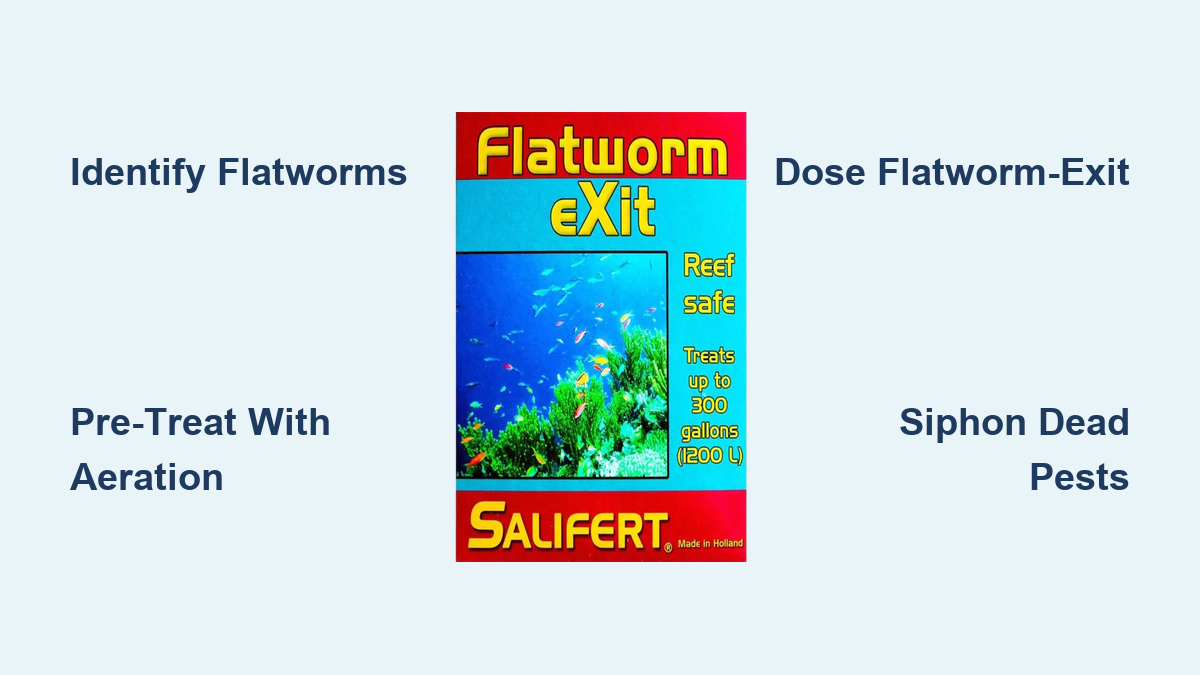
For active infestations, Salifert Flatworm-Exit remains the most reliable solution when applied correctly. Never skip these safety steps—the medication itself is safe, but flatworm die-off toxins kill tanks.
Critical Pre-Treatment Preparation Checklist
- Remove all chemical filtration (carbon, GFO) 24 hours pre-treatment
- Install heavy aeration using at least two air stones running at maximum flow
- Perform 25% water change with pre-mixed saltwater (match temperature/salinity)
- Place fresh carbon (ROX 0.8 or equivalent) in a reactor bag near your return pump
Why this works: Aeration prevents oxygen depletion from decomposing flatworms, while fresh carbon captures released toxins. Skipping aeration causes 90% of treatment failures.
Exact Dosing & Removal Process for 10-30 Gallon Tanks
For a 13.5-gallon nano tank (common infestation scenario):
1. Mix 8 drops of Flatworm-Exit in 1 cup tank water (1.5x dose for severe cases)
2. Pour solution slowly across the surface with pumps running
3. Within 60 minutes: Flatworms turn white and detach—immediately siphon them using airline tubing
4. At 90 minutes: Perform 30% water change
5. At 24 hours: Replace carbon and do another 25% water change
Pro Tip: Run filter floss in your sump during treatment to catch dislodged flatworms. Never let dead pests decompose in-tank—they release toxins for 48+ hours.
Biological Warfare: Natural Predators That Actually Work

While chemicals handle active outbreaks, these predators prevent regrowth—but choose wisely for your tank size.
Six-Line Wrasse: The Nano Tank Specialist
This 3-inch fish devours flatworms in tanks as small as 15 gallons. Unlike aggressive wrasses, it ignores corals and shrimp. Critical requirement: Provide 2+ hiding spots in rockwork. Without caves, it stresses corals by constantly hunting. Expect noticeable reduction in 2-3 weeks.
Blue Velvet Nudibranch: The Precision Strike Option
For severe infestations, add 1 nudibranch per 10 gallons directly onto flatworm colonies. They consume pests within 72 hours but starve once flatworms are gone. Only use in display tanks—never quarantine—since they die without food. Monitor daily; remove if flatworms vanish in 5 days.
Springer’s Damselfish: The Peaceful Alternative
Ideal for tanks under 20 gallons where wrasses may be too aggressive. This 1.5-inch fish eats flatworms without bothering corals. Key advantage: It survives on microfauna after flatworms are gone. Introduce only after chemical treatment to avoid starvation.
Emergency Flatworm Die-Off Rescue Procedures
If fish gasp or corals bleach during treatment, toxins are spiking. Act within minutes:
- MAXIMIZE AERATION
Turn on every air stone and point powerheads at the surface - PERFORM 50% WATER CHANGE
Use pre-mixed saltwater at exact tank temperature - ADD DETOXIFIER
Dose 2x Seachem Prime (5ml per 10 gallons) to neutralize toxins - REMOVE DEAD FLATWORMS
Siphon every visible white patch immediately
Do NOT add more medication. This protocol reverses 80% of emergency scenarios if implemented within 30 minutes of distress signs.
Quarantine System: Your Ultimate Flatworm Prevention
90% of infestations start with new corals. Your quarantine protocol must include:
Mandatory 3-Step Coral Dip Process
- Freshwater Dip (3 minutes)
Use RO/DI water matched to tank temperature/pH - Iodine Dip (5 minutes)
3 drops Betadine per gallon of tank water - Flatworm-Exit Dip (5 minutes)
2 drops per cup of tank water in separate container
Never skip the freshwater dip first—it loosens flatworm grip. After dipping, quarantine corals for minimum 21 days in a bare tank with no substrate. Flatworm eggs hatch in 14 days; waiting 21 days ensures no survivors hitchhike into your display.
Nano Tank Quarantine Setup Under $50
- 10-gallon tank with heater
- Sponge filter (no carbon)
- Single powerhead for flow
- Zero live rock (use PVC pipes for hiding spots)
This bare-bones system catches pests before they reach your main tank. Always treat new corals here before display introduction.
Long-Term Flatworm Prevention Maintenance
Keep your tank inhospitable to flatworms with these daily habits:
- Nutrient Control: Maintain nitrates below 5 ppm and phosphates under 0.03 ppm through weekly 15% water changes
- Targeted Feeding: Use a baster to deliver food directly to fish—never let food hit the sandbed
- Weekly Siphon Sessions: Vacuum rock crevices during water changes using 1/4″ airline tubing
- Refugium Boost: Add 2 cups Chaetomorpha macroalgae to your sump—competes with flatworm food sources
Pro Tip: Run your protein skimmer 24/7. Flatworms thrive in low-oxygen zones; strong surface agitation prevents their colonization.
Final Flatworm Eradication Checklist
Eliminating flatworms requires precision, but these steps guarantee success:
1. Confirm you have Rust Brown Flatworms or Brown Planaria
2. Treat with Flatworm-Exit using aeration/carbon protocol
3. Siphon every dead flatworm within 90 minutes of treatment
4. Quarantine all new additions for 21+ days with triple-dipping
5. Maintain low nutrients through water changes and targeted feeding
The most critical mistake reef keepers make? Assuming one treatment finishes the job. Flatworm eggs survive in rock pores—always repeat chemical treatment after 7 days to catch hatched juveniles. Pair this with a Six-Line Wrasse for ongoing protection, and your tank will stay flatworm-free permanently. Remember: Prevention through quarantine isn’t optional—it’s the only way to avoid repeating this nightmare. Start your dip protocol today, and you’ll never again watch helplessly as rust-colored invaders smother your reef.