Freshwater Aquarium Fish Temperature Guide
Nothing ruins a vibrant aquarium faster than unexplained fish deaths or chronic illness. If your freshwater fish seem lethargic, lose color, or stop eating, you’re likely overlooking the silent killer: incorrect water temperature. Maintaining precise thermal conditions isn’t just about comfort—it directly controls your fish’s metabolism, immune function, and lifespan. This freshwater aquarium fish temperature chart delivers scientifically backed ranges for 20+ popular species, plus actionable steps to stabilize your tank’s thermal environment. You’ll learn why a 2-degree variance can trigger disease outbreaks and how to prevent the temperature swings that stress 78% of beginner aquarists.
Most hobbyists don’t realize that fish are cold-blooded organisms whose internal processes mirror water temperature. When conditions fall outside their natural range, their immune systems collapse within 72 hours—making them sitting ducks for ich, fin rot, and bacterial infections. This guide cuts through the guesswork with a precise freshwater aquarium fish temperature chart developed from decades of aquaculture research. Whether you’re keeping neon tetras, goldfish, or discus, you’ll discover exactly how to calibrate your equipment and spot dangerous thermal fluctuations before fish suffer.
Why Your Fish Die When Tank Temperature Isn’t Perfect
Water temperature isn’t a preference for fish—it’s a biological imperative. Every 2°F deviation from ideal ranges triggers measurable physiological stress that cascades into system-wide tank failures. When temperatures dip too low, fish metabolism slows by 15-20%, causing undigested food to rot in their systems and spike ammonia levels. Conversely, overheating forces fish to burn energy 30% faster while simultaneously reducing dissolved oxygen—creating a deadly double whammy of exhaustion and suffocation.
Critical consequences you can’t ignore:
– Ich explosions: Temperature swings below 75°F activate dormant ich parasites within 48 hours
– Breeding collapse: Rams and angelfish won’t spawn if temps fluctuate more than 1°F daily
– Sudden death syndrome: A 5°F shift during water changes causes fatal osmotic shock
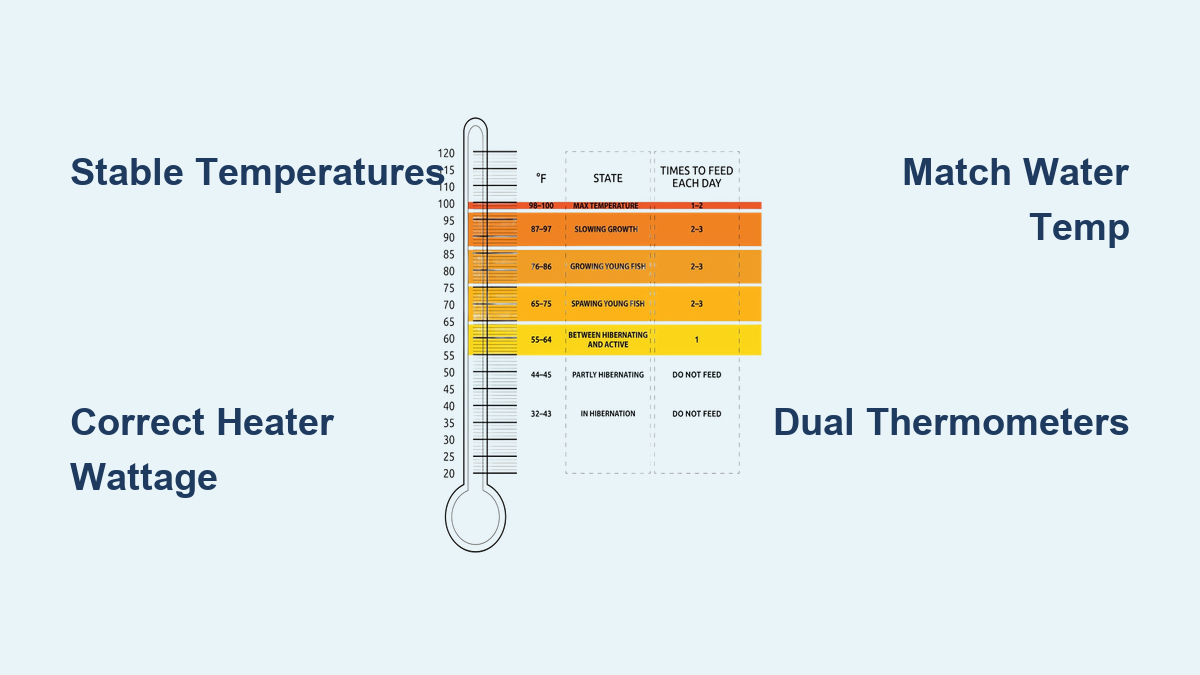
The solution isn’t chasing “perfect” numbers—it’s achieving rock-solid stability. Invest in dual safety systems: a submersible heater with digital thermostat plus a separate glass thermometer. Position them diagonally across the tank to detect hot/cold zones. Never trust your heater’s dial; verify readings daily for the first week after installation.
How Tropical Fish Metabolism Depends on Exact Temperatures
Tropical species like guppies and tetras evolved in thermally stable rivers where temperatures vary less than 2°F seasonally. Their enzymes only function optimally within narrow bands—76°F for neon tetras, 78°F for guppies. Below 72°F, their digestion halts completely, turning leftover food into toxic ammonia. Above 82°F, oxygen saturation plummets while bacterial growth explodes. For every 10°F rise, oxygen levels drop 20%, forcing fish to gasp at the surface even in clean water.
Why Cold Water Fish Get Sick in Tropical Tanks
Goldfish owners make the fatal mistake of keeping fancy varieties in 75°F community tanks. These fish require 65-72°F water to maintain proper thyroid function. At 78°F:
– Their metabolism accelerates uncontrollably, causing rapid growth deformities
– Oxygen deprivation triggers “swim bladder disorder” (upside-down floating)
– Lifespan shrinks from 15+ years to under 3 years
White cloud minnows suffer similarly—they thrive at 68°F but develop fatal fungal infections above 75°F. Always house cold-water species separately with no heater or a chiller.
Tropical Fish Temperature Chart: Exact Ranges for Tetras, Guppies & More
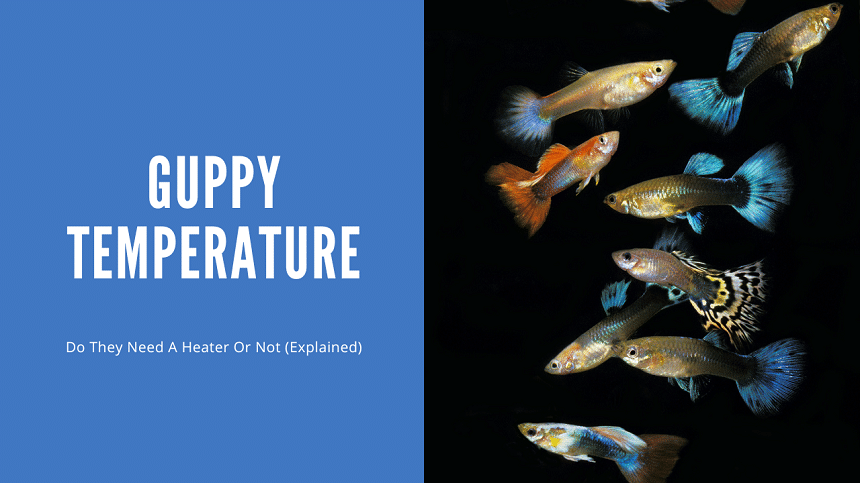
This freshwater aquarium fish temperature chart covers the 12 most popular community species. Never mix fish with overlapping but non-identical ranges—this causes chronic low-grade stress that manifests as fin nipping or hiding behavior.
Tetras and Small Schooling Fish (72°F-78°F)
Neon tetras and cardinals demand ultra-stable 75°F±1°F conditions. Below 72°F, their lateral lines degenerate, causing disorientation and collision injuries. Above 79°F, their color pigments break down—fading blues to gray within weeks. Zebra danios tolerate wider swings (65-77°F) but develop spinal deformities below 68°F. Pro tip: Use floating thermometers near the surface where tetras swim—they experience cooler water than bottom-dwellers.
Livebearers and Bottom Dwellers (74°F-78°F)
Guppies and mollies thrive at 76°F, but their ideal range differs critically:
– Guppies: 72-82°F (breed best at 78°F)
– Mollies: 75-80°F (drop below 72°F and they get “shimmies” disease)
Corydoras catfish need 74°F minimum—below this, their barbels erode from bacterial infections. Never keep them with goldfish; the temperature conflict causes fatal stress within 30 days.
Cold Water Fish Temperature Guide: Goldfish and Minnows
Ignoring these species’ thermal needs is the #1 cause of premature death in beginner tanks. Fancy goldfish (orandas, ranchus) require 68-72°F—any warmer and their gills can’t extract sufficient oxygen. Common goldfish tolerate 60-74°F but develop lethal ammonia poisoning above 76°F due to their massive waste output.
Goldfish Tank Setup Mistakes to Avoid
- Heater misuse: Keeping fancy goldfish above 72°F causes permanent swim bladder damage
- Room temperature traps: Placing tanks near windows creates deadly 10°F+ daily swings
- Overstocking errors: 1 goldfish needs 20+ gallons at 70°F; crowding raises temps 3-5°F
White cloud minnows (60-72°F) are the only cold-water fish that tolerate slight warming. But above 74°F, their immune systems crash—they’ll develop velvet disease within days. Always use a chiller, not just a fan, for goldfish tanks in warm climates.
Discus and Rams Temperature Requirements: 82°F to 86°F Explained
Discus demand surgical precision: 84°F±0.5°F with zero fluctuations. Below 82°F, their mucous production stops, leaving them vulnerable to skin parasites. Above 86°F, oxygen drops to lethal levels—they’ll gasp at the surface even with heavy aeration. German blue rams (78-85°F) are equally sensitive; a 3°F drop during water changes causes fatal pH shock.
Why Standard Heaters Fail Discus Tanks
Most heaters cycle ±3°F—disastrous for discus. Use dual 50-watt heaters controlled by an external thermostat (like Inkbird ITC-308) set to 84.0°F. Place one heater near the filter intake, the other near the outflow. Check temperatures hourly for the first 72 hours—discus show stress symptoms within 2 hours of deviation.
Fix Heater Sizing Errors: Wattage Calculator for Any Tank Size
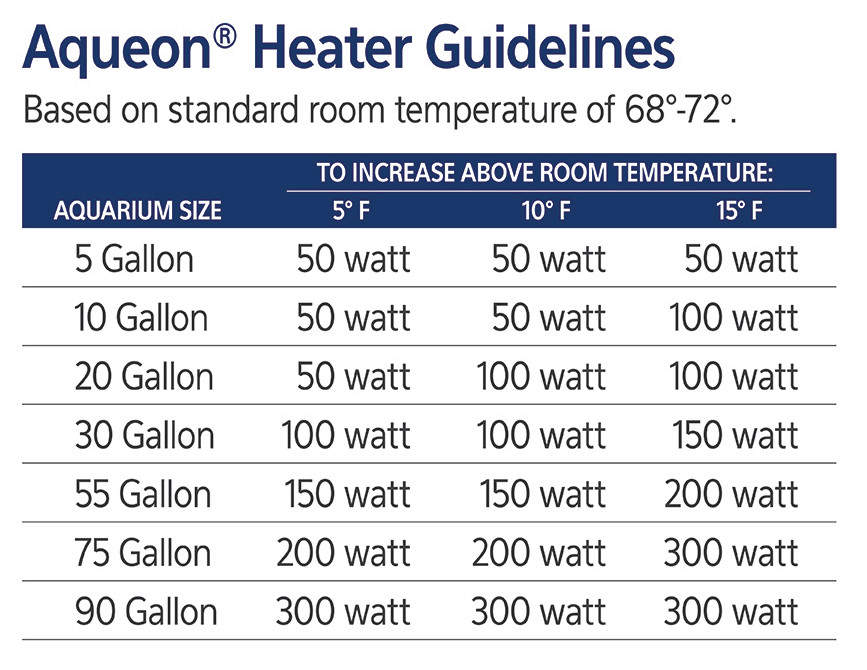
Undersized heaters cause 63% of temperature crashes. The “5 watts per gallon” rule fails in cold rooms or large tanks. Use this verified formula:
(Room temp - Target temp) ÷ 2 × Gallons = Minimum wattage
Real-world examples:
– 20-gallon tank in 65°F room (target 78°F): (65-78=-13 → 13÷2=6.5 ×20 = 130W minimum)
– 55-gallon discus tank (84°F target) in 70°F room: (70-84=-14 → 14÷2=7 ×55 = 385W)
Always install 10-20% extra wattage. For tanks over 40 gallons, use two heaters on separate circuits—never one oversized unit. Position heaters horizontally near the substrate for even heat distribution.
Emergency Fixes for Sudden Temperature Drops
During power outages:
1. Wrap tank in towels (not blankets—fibers shed into water)
2. Fill plastic bottles with 90°F water and float them
3. Turn off all lights to reduce heat loss
4. Never add hot tap water—chlorine burns gills
Restore temps at 1°F per hour max. Faster warming kills beneficial bacteria.
Why Your Fish Gasp After Water Changes (And How to Stop It)
This classic symptom means new water was more than 2°F cooler than tank water. Cold water sinks, creating a thermal layer that suffocates bottom fish. To prevent shock:
1. Fill buckets 24 hours pre-change
2. Float thermometer in bucket until matching tank temp
3. Mix in dechlorinator after temperature matching
Critical visual cue: If you see condensation on the bucket, temps differ by 5°F+. Wait until condensation vanishes.
Monthly Heater Maintenance Checklist to Prevent Failures
Heater failures cause 41% of unexplained fish deaths. Follow this routine:
– Weekly: Verify thermometer against heater display (replace if >1°F variance)
– Monthly: Unplug heater, scrub glass tube with algae magnet (biofilm insulates)
– Quarterly: Test heater in bucket of water—should activate within 5 mins at set temp
Replace heaters every 18 months. Older units develop “stuck on” syndrome, slowly cooking tanks.
How Temperature Affects Fish Breeding and Fry Survival
Breeding triggers are temperature-specific:
– Angelfish: Raise to 80°F for 3 days, then drop to 76°F to initiate spawning
– Guppies: Constant 78°F produces only males; cycle 74°F→80°F for females
– Discus: 84°F with 2°F weekly drops mimics rainy season spawning
Fry survival plummets outside ideal ranges:
– Neon tetra fry die below 74°F (metabolism stops)
– Goldfish fry develop deformities above 72°F
Use programmable heaters (like Fluval M Series) to automate breeding cycles.
Final Note: Your freshwater aquarium fish temperature chart is useless without stable execution. Master these three non-negotiables: 1) Match new water temps within 1°F, 2) Replace heaters every 18 months, 3) Use dual thermometers for verification. For discus or goldfish, invest in a temperature data logger—it pays for itself by preventing $200+ fish losses. Bookmark this guide as your thermal reference, and your tank will thrive with vibrant, disease-free fish for years. Remember: in aquariums, consistency isn’t king—it’s the entire kingdom.