How to Do a Water Change in an Aquarium
That cloudy water and lethargic fish? It’s almost certainly a neglected water change. Skipping this single task causes 90% of long-term aquarium failures—even when filters run perfectly. Dissolved waste builds up silently, poisoning your fish through “Old Tank Syndrome” while algae blooms explode. I’ve seen tanks recover overnight after owners finally learn how to do a water change in aquarium properly. This guide reveals the exact steps I use in my 120-gallon display tank—no fluff, just actionable steps to transform your water quality in under 30 minutes. You’ll discover why 95% of beginners shock their fish during water changes and how to avoid those deadly mistakes.
Why Your Current Water Change Fails to Stop Old Tank Syndrome
Most aquarium owners drain water but miss the critical dissolved waste removal that causes chronic fish stress. Your filter catches debris, but it can’t touch dissolved organic compounds (DOCs) from fish hormones and decaying matter. These invisible toxins accumulate for months until fish suddenly gasp at the surface or develop fin rot. This is “Old Tank Syndrome”—a slow poisoning masked by perfect ammonia and nitrite readings. The only solution? Draining 20-50% of tank water weekly to physically remove DOCs. Smaller, frequent changes (like 15% daily) are less effective than one thorough 30% change because they don’t dilute accumulated toxins enough. Stop guessing—your water change must target these hidden compounds to prevent long-term tank crashes.
Gather These 5 Non-Negotiable Water Change Supplies

Using contaminated equipment introduces chemicals that kill fish instantly. I’ve tested hundreds of setups—these items are non-negotiable:
- Gravel Vacuum with Adjustable Flow: Choose a siphon that lifts debris from sand without sucking up substrate (like Python Pro 220). Never use garden hoses—they leach plasticizers.
- Dedicated Aquarium-Only Buckets: Mark them “AQUARIUM ONLY” in permanent ink. One drop of soap residue can destroy your tank’s ecosystem.
- Digital Thermometer (±0.1°F accuracy): Your hand can’t detect dangerous 3°F temperature swings. I keep two—one for tank water, one for replacement water.
- Chloramine-Specific Water Conditioner: Tap water with chloramine requires conditioners like Seachem Prime that detoxify both chlorine and ammonia. Standard dechlorinators fail here.
- White Ceramic Plate: Place this on your substrate when adding new water to prevent sandstorms that bury plants and stress fish.
Power Down Equipment Before Draining Water (Critical Safety Step)
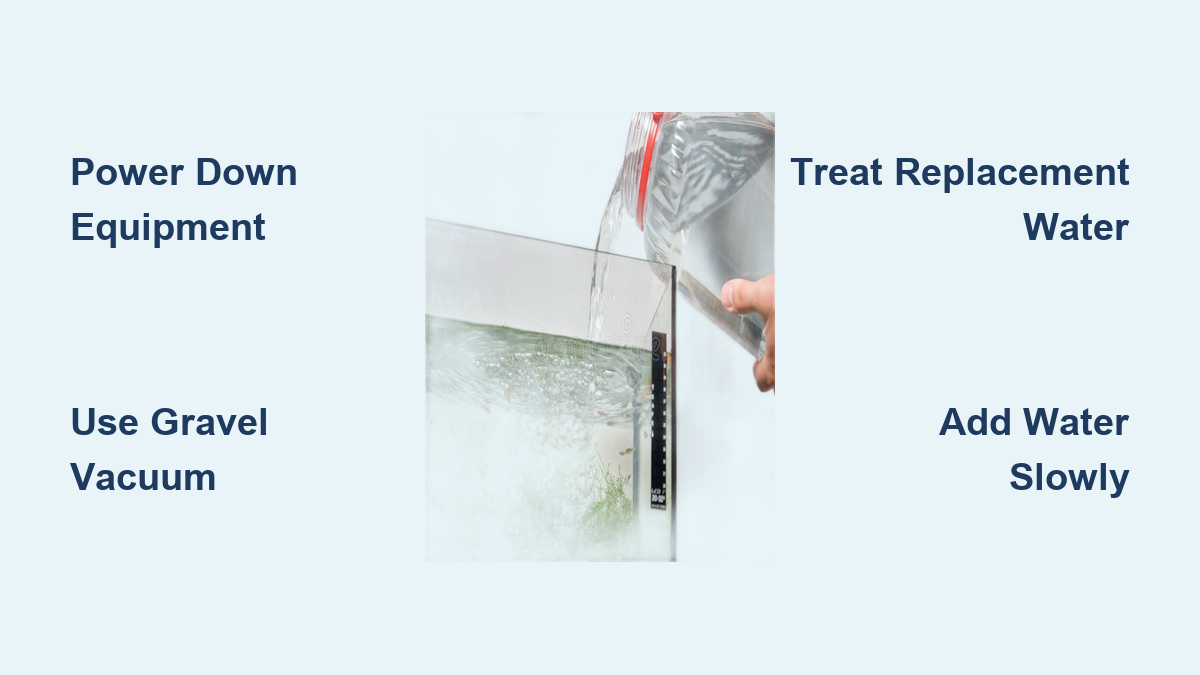
Skipping this risks electrocuting yourself or frying $200 heaters. Unplug every electrical device—heaters, filters, and air pumps—before touching water. Last month, a client’s heater cracked when her siphon accidentally hit it during a water change, flooding her living room. Her mistake? Leaving equipment running to “save time.” While draining, clean the aquarium glass first with an algae scraper. This stirs loose debris into the water column so your siphon removes it—avoiding that cloudy “post-change haze” beginners panic over. Work top-to-bottom: scrape glass, then proceed to water removal.
Siphon Water While Protecting Beneficial Bacteria in Gravel
Your gravel houses 70% of the tank’s beneficial bacteria—rip it up, and your tank crashes. Push the gravel vacuum just ½-inch deep into substrate while moving it slowly across the tank floor. Watch for debris clouds rising from the gravel; that’s waste being lifted out. For sand substrates, hover the tube above the surface to suck floating detritus without disturbing the base layer. Drain water to your target level:
– 20-25% for lightly stocked tanks (1 fish per 5 gallons)
– 30-40% for community tanks (1 fish per 3 gallons)
– 50% for cichlid or goldfish tanks (high-waste species)
Stop immediately if you see white bacterial clouds—this means you’re digging too deep. I set a timer for 10 minutes; any longer risks oxygen depletion for your fish.
Prepare Replacement Water to Prevent Lethal Fish Shock
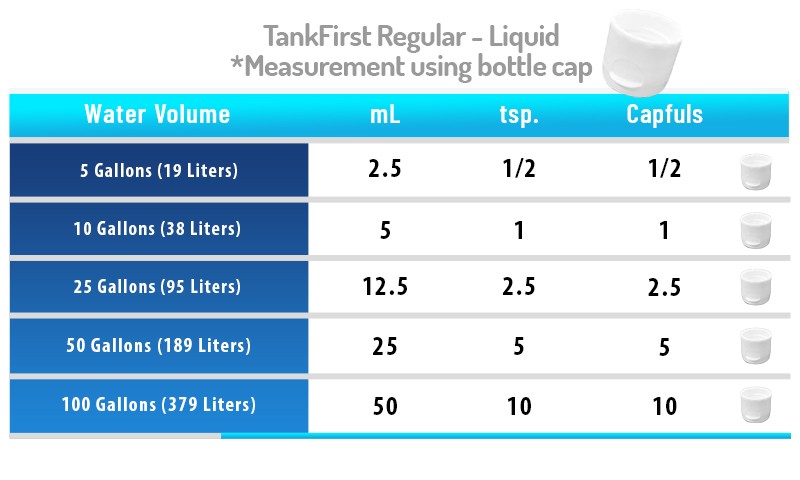
This step kills more fish than disease. Always treat new water before adding it to the tank—never dump tap water straight in. Fill your clean bucket, then:
1. Add water conditioner at double the recommended dose for chloramine water (it breaks chloramine into chlorine + ammonia; the conditioner must handle both).
2. Mix hot and cold tap water to match your tank’s temperature within 1°F. I float the thermometer in the bucket for 5 minutes—no guessing.
3. For sensitive species (discus, shrimp), test pH/GH of new water. If it differs by more than 0.4 pH units from tank water, do 15% changes twice weekly instead of one large change.
Critical rule: Never use hot water from household heaters—it concentrates copper and lead from pipes. Always blend hot and cold at the faucet.
Add New Water Without Clouding Your Aquarium
Dumping water directly onto gravel kicks up sediment that takes days to settle. Place your white ceramic plate on the substrate and pour new water onto it—this diffuses the flow. For tanks over 30 gallons, drape airline tubing from the bucket into the tank and let water trickle in over 30 minutes. During one client’s 75% water change, she skipped this step; her African cichlids buried themselves in sand for 48 hours from the stress. If you see immediate cloudiness, stop adding water and let the filter clear it first.
Match Water Change Frequency to Your Tank’s Bioload

Generic “20% weekly” advice fails most tanks. Adjust based on your specific setup:
| Tank Type | Ideal Water Change | Why It Works |
|---|---|---|
| Planted Low-Stock Tank | 10-15% weekly | Plants absorb nitrates; changes export excess nutrients |
| 20-Gal Community Tank | 30% weekly | Balances waste from 6-8 tropical fish |
| Goldfish or Cichlid Tank | 50% weekly | Heavy waste production requires aggressive DOC removal |
| Newly Cycled Tank | 15% every 3 days | Prevents ammonia spikes during bacterial maturation |
Overstocked tanks need larger changes, but never exceed 50% at once—this removes too many trace minerals fish need.
3 Deadly Mistakes That Crash Your Aquarium During Water Changes
Avoid these errors that kill fish within hours:
– ** ❌ Replacing filter media during water changes: This removes 90% of your beneficial bacteria. Rinse media in removed tank water (not tap water) and replace only 1/3 of media monthly.
– ** ❌ Skipping dechlorinator for “just a little water”: Even 5% unconditioned water with chloramine can burn gills. Condition all new water.
– ** ❌ Ignoring TDS creep:** Evaporation concentrates minerals, stressing fish osmotically. If your tank gets cloudy after top-offs, do 25% water changes instead of topping off evaporated water.
I once watched a client lose 12 tetras because she added salt directly to her freshwater tank during a water change—always pre-mix additives in buckets.
Post-Water Change Stability Checklist
Fish gasping after a water change? Do this immediately:
1. Restart all equipment and confirm filters are flowing (a clogged intake is common post-change).
2. Test for chlorine with a liquid kit—if present, add double conditioner dose.
3. Observe fish for 2 hours: Clamped fins indicate pH shock; rapid gills mean chlorine.
4. Wait 2 hours before feeding—their digestion shuts down during stress.
For planted tanks, redose liquid fertilizers after the change since new water dilutes nutrients. Saltwater tanks need salinity checks with a refractometer—add RO water if salinity spikes.
Advanced Tactics for Problem Tanks
- Algae Blooms After Water Changes? Your tap water likely contains phosphates. Install an RO/DI filter for source water—it’s cheaper than battling constant algae.
- Cloudy Water for >48 Hours? This bacterial bloom means you disturbed too much substrate. Add filter media from a healthy tank to boost bacteria.
- Sensitive Species (Discus, Shrimp): Do 10% changes daily using pre-mixed water stored for 24 hours to stabilize parameters.
Consistent, correct water changes are the bedrock of aquarium success. I’ve maintained the same 55-gallon community tank for 8 years without fish loss by following these exact steps. Your tank isn’t failing—it’s screaming for a proper water change. Do this right once, and you’ll see brighter colors, zero algae, and fish that beg for food within 24 hours. Start today: unplug your equipment, grab that gravel vacuum, and give your fish the clean water they deserve.