How Aquarium Protein Skimmers Work
Your reef tank’s water looks cloudy. Nuisance algae keeps creeping across your live rock. Despite regular water changes, your corals aren’t thriving like they should. Chances are, dissolved organic compounds are silently poisoning your aquatic ecosystem. This is where protein skimmers become your secret weapon. How do aquarium protein skimmers work? They remove harmful waste before it breaks down, creating the pristine water conditions that delicate marine life demands. Understanding this process isn’t just technical knowledge—it’s the difference between a struggling tank and a vibrant underwater paradise.
Protein skimmers, also called foam fractionators, perform a critical biochemical process that mechanical and biological filtration can’t match. They target dissolved organic compounds that would otherwise decompose into ammonia, nitrites, and nitrates—compounds that fuel algae growth and stress sensitive corals. The magic happens through a sophisticated physical-chemical process that separates waste from water using nothing but air bubbles and surface tension. When you see that dark “skimmate” collecting in your cup, you’re witnessing organic pollution being permanently removed from your system.
Unlike filters that trap debris, protein skimmers prevent waste accumulation at the molecular level. This proactive approach creates the low-nutrient environment essential for SPS corals and other demanding marine species. By answering how do aquarium protein skimmers work, you gain the knowledge to optimize this vital equipment and maintain truly exceptional water quality in your saltwater aquarium.
Why Dissolved Organics Destroy Reef Tank Stability
Dissolved organic compounds (DOCs) are invisible threats lurking in your aquarium water. These microscopic pollutants include proteins, amino acids, carbohydrates, and fatty acids—waste products from fish excretion, uneaten food, and decaying organisms. Left unchecked, DOCs break down into nitrogenous waste that fuels algae blooms and stresses marine life. How do aquarium protein skimmers work against this invisible threat? They intercept DOCs before decomposition begins.
How DOCs Create a Vicious Cycle in Your Tank
- Breakdown process: DOCs decompose into ammonia → nitrites → nitrates
- Algae consequences: Elevated nitrates directly feed nuisance algae
- Oxygen depletion: Bacterial blooms consume oxygen while breaking down DOCs
- Coral impact: High DOC levels cause coral tissue recession and poor polyp extension
The critical window for intervention is before DOCs decompose. Protein skimmers operate in this narrow timeframe, removing waste in its dissolved state. Without this preemptive filtration, your tank constantly plays catch-up with nutrient pollution, requiring more frequent water changes and chemical interventions.
The Bubble Science: Adsorption vs. Absorption in Protein Skimming
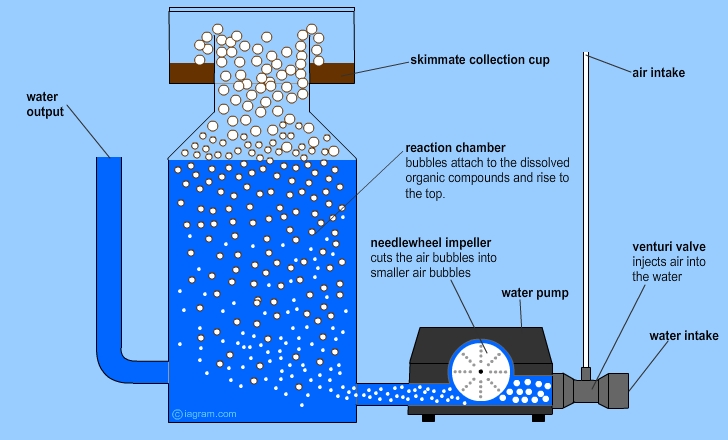
Protein skimmers exploit a fundamental chemical principle called adsorption—where molecules adhere to a surface rather than being absorbed into a material. This distinction is crucial to understanding how do aquarium protein skimmers work. When billions of microbubbles rise through your aquarium water, organic molecules with hydrophobic (water-repelling) properties stick to the bubble surfaces.
The 4-Stage Skimming Process Explained
- Bubble Generation: The skimmer pump creates a dense cloud of microbubbles (0.5-1mm diameter) in the reaction chamber
- Organic Attachment: Dissolved organics adsorb onto bubble surfaces as water flows through the chamber
- Foam Concentration: Rising bubbles form a wet foam that transitions to dry foam at the top
- Waste Removal: Collapsed foam (skimmate) collects in the cup for manual removal
The smaller the bubbles, the greater the total surface area available for adsorption. A needle-wheel skimmer generating 1mm bubbles creates 1,000 times more surface area than a skimmer producing 1cm bubbles. This is why bubble size directly determines skimming efficiency—more surface area means more waste removal.
Essential Protein Skimmer Components and Their Functions

Every effective protein skimmer contains these critical components working in harmony. Knowing how each part contributes helps you troubleshoot issues and optimize performance.
Reaction Chamber Design Secrets
The reaction chamber’s height-to-width ratio determines contact time between bubbles and water. Taller, narrower chambers provide longer interaction periods—essential for thorough waste removal. The ideal chamber maintains a slow, steady bubble ascent (2-4 inches per second) allowing maximum adsorption time. Look for chambers with internal baffles that prevent water channeling and ensure uniform bubble distribution.
Skimmer Pump Technology Breakdown
Your skimmer’s pump does double duty: moving water AND creating microbubbles. Three technologies dominate the market:
– Needle-wheel pumps: Most efficient for home aquariums (90% of modern skimmers)
– Venturi injectors: Use water pressure differentials to suck in air
– Aspirating pumps: Combine impeller design with air intake tubes
The needle-wheel’s precision-cut “pins” shear air into microbubbles while the impeller pumps water. Higher-quality skimmers feature ceramic shafts and precision-balanced wheels that maintain bubble consistency for years without performance degradation.
Collection Cup Adjustment Mechanics
The collection cup’s neck height controls skimmate dryness. Here’s what to watch for:
– Wet skimmate (light brown, watery): Water level too high in reaction chamber
– Dry skimmate (dark brown, thick): Water level too low in reaction chamber
– Ideal consistency: Maple syrup texture with minimal water content
Adjust the gate valve or standpipe to change the water level. Lowering the water level makes skimmate drier by allowing bubbles more time to concentrate before entering the cup. Finding this sweet spot prevents frequent cup overflows while maximizing waste removal.
Choosing the Right Skimmer Type for Your Aquarium Setup
Not all protein skimmers work equally well in every system. Matching skimmer type to your tank configuration prevents common setup mistakes.
In-Sump Skimmers: The Reef Keeper’s Gold Standard
For tanks with dedicated sumps (90% of serious reef systems), in-sump skimmers offer unmatched advantages:
– Easy access for maintenance without disturbing display tank
– Larger reaction chambers for greater efficiency
– Quiet operation away from viewing area
– No evaporation issues affecting performance
Pro Tip: Position your skimmer in the first chamber after your mechanical filter. This ensures pre-filtered water enters the skimmer, preventing large debris from clogging the reaction chamber.
Hang-On-Back and In-Tank Skimmers: Compact Solutions
For nano tanks or all-in-one systems without sumps:
– Hang-on-back models: Mount directly on tank rim (best for 10-30 gallon systems)
– In-tank units: Submerged within display or rear chamber (ideal for pico reefs)
– Critical limitation: Evaporation affects water level consistency, requiring frequent adjustment
These compact skimmers work effectively but demand more attention. Check daily during initial setup to maintain proper water levels in the reaction chamber.
Setting Up Your Protein Skimmer for Immediate Results
Proper installation prevents 80% of common skimmer problems. Follow these precise steps for optimal performance.
The Critical Break-In Period Protocol
New acrylic components need conditioning before efficient skimming begins:
1. Run the skimmer continuously for 48 hours before adding to your tank
2. Fill the reaction chamber completely with saltwater
3. Allow natural biofilm to develop on chamber walls
4. Expect inconsistent foam for first 24 hours—this is normal
During this period, the microscopic pores in new acrylic create unstable bubbles. The developing biofilm stabilizes bubble formation, allowing consistent foam production. Skipping this step causes frustrating “why won’t my skimmer work?” scenarios.
Perfect Water Level Adjustment Sequence
- Start with water level at manufacturer’s midpoint mark
- Run skimmer for 15 minutes to establish bubble column
- Adjust gate valve downward in 1/8″ increments
- Wait 20 minutes between adjustments for changes to stabilize
- Stop when skimmate resembles weak coffee (not tea, not motor oil)
The ideal setting produces steady foam collection without overflowing the cup. Most reef keepers run their skimmers slightly drier than fish-only systems to maximize organic removal for sensitive corals.
Troubleshooting Skimmer Performance Issues

When your protein skimmer underperforms, these targeted fixes solve 95% of problems.
No Foam Production: The Air Intake Check
If bubbles appear but no foam forms:
– Immediate action: Remove and clean the air intake tube (often clogged by dust)
– Common culprit: Salt creep blocking the venturi valve
– Test method: Submerge air tube end in water—if bubbles stop, the intake is clear
Most “broken skimmer” emergencies are simply blocked air pathways. A cotton swab and vinegar soak solve this in minutes.
Overflowing Collection Cup: The Water Level Fix
When skimmate floods your sump:
– Quick solution: Raise the collection cup 1/4 inch
– Permanent fix: Lower reaction chamber water level via gate valve
– Critical check: Ensure skimmer isn’t positioned near return pump turbulence
Water movement near the skimmer disrupts bubble formation. Reposition if necessary—skimmers need calm water entry for optimal performance.
Protein Skimmer Maintenance Schedule for Peak Performance
Consistent maintenance prevents the gradual performance decline that ruins water quality.
Weekly Maintenance Checklist
- Inspect air intake for blockages
- Wipe collection cup neck with vinegar-soaked cloth
- Check pump impeller for salt buildup
- Empty collection cup when 1/3 full (prevents overflow)
Monthly Deep Cleaning Procedure
- Disassemble pump and reaction chamber
- Soak components in 1:4 vinegar/water solution for 30 minutes
- Use soft brush to remove scale from needle-wheel
- Rinse thoroughly with freshwater
- Reassemble and restart
Neglecting this routine causes skimmer efficiency to drop 40% within three months. Well-maintained skimmers operate at peak performance for years.
Why Protein Skimmers Are Non-Negotiable for Reef Tanks
How do aquarium protein skimmers work to transform your reef ecosystem? They create the foundational water quality that allows corals to thrive. By removing dissolved organics before they decompose, skimmers:
– Reduce nitrate and phosphate accumulation by 50-70%
– Increase oxygen levels through bubble aeration
– Prevent yellowing of aquarium water
– Minimize the need for chemical filtration media
The dark skimmate you remove represents pollution that would otherwise stress your entire system. For serious reef keepers, a properly functioning protein skimmer isn’t optional equipment—it’s the cornerstone of a stable, thriving marine ecosystem. When you understand the science behind foam fractionation, you gain the power to maintain exceptional water quality with less effort and fewer interventions.