How to Diffuse Water Flow in Aquarium
Is your betta fish constantly hiding from a powerful filter current? Do delicate plants in your aquascape get battered by relentless water movement? Many aquarium enthusiasts unknowingly create stressful environments for their fish by overlooking one critical element: water flow diffusion. How to diffuse water flow in aquarium setups is essential knowledge that separates thriving tanks from struggling ones. Properly diffused water circulation mimics natural river and lake environments, allowing fish to swim comfortably while ensuring plants receive nutrients without being uprooted. In this guide, you’ll discover practical, immediate solutions to transform overpowering currents into gentle, life-sustaining flows that benefit every inhabitant in your tank.
Strong water currents don’t just inconvenience your fish—they can cause chronic stress that weakens immune systems and leads to disease. For sensitive species like bettas, guppies, and dwarf shrimp, excessive flow creates constant swimming battles that exhaust energy reserves needed for growth and reproduction. Meanwhile, in planted tanks, undiffused flow prevents CO2 and nutrient absorption while uprooting delicate stems. The good news is you don’t need expensive equipment to fix this common problem. By implementing the techniques in this guide, you’ll create balanced water movement that maintains filtration efficiency while providing calm zones where fish can rest and plants can flourish.
Why Strong Currents Harm Delicate Fish and Plants
Powerful, unidirectional water flow creates unnatural conditions that stress aquatic life in multiple ways. Fish that naturally inhabit slow-moving streams or ponds—like bettas, goldfish, and most tetras—must constantly swim against currents just to maintain position, burning calories that should go toward growth and immune function. This chronic stress makes them more susceptible to diseases like fin rot and ich. For bottom-dwellers like corydoras, excessive flow prevents natural foraging behavior as food particles get swept away before they can eat.
Plant health suffers equally from undiffused flow. Delicate stem plants like Rotala and Hemianthus require gentle, multidirectional currents to absorb nutrients through their leaves. When subjected to a single strong jet, their growth becomes stunted and leaves develop holes from constant battering. Even hardy plants like Anubias can detach from hardscape when rhizomes fail to anchor against relentless water movement. The solution isn’t reducing overall flow—which is vital for oxygenation and waste removal—but strategically diffusing it to create varied current patterns that mimic nature.
Identifying Dangerous Water Flow Patterns in Your Tank
Measuring Your Aquarium’s Flow Rate: GPH Guidelines by Tank Size
Your filter’s flow rate should circulate your tank’s entire volume 5-10 times per hour. For a standard 20-gallon freshwater tank, this means a filter rated for 100-200 GPH (gallons per hour). However, this output often creates a single powerful jet that causes problems. Critical mistake: Many beginners install filters rated for the maximum tank capacity without considering species needs. A betta tank actually needs only 3-4x turnover (60-80 GPH for 20 gallons), while a heavily stocked cichlid tank might require 10x (200 GPH).
Use this quick reference guide for appropriate flow rates:
– Betta/shrimp tanks: 3-4x tank volume per hour
– Community freshwater tanks: 5-7x turnover
– Planted tanks: 6-8x turnover (higher for CO2-injected tanks)
– Saltwater reef tanks: 10-20x turnover
How Tank Layout Creates Dead Zones and Turbulent Currents
Your aquarium’s physical layout dramatically affects flow patterns. Tall plants or dense hardscape arrangements create barriers that split currents, leaving stagnant areas behind them where debris accumulates. Conversely, open tanks with minimal decor allow unimpeded flow that becomes overwhelming in certain zones. The ideal setup creates variable flow zones—gentle currents near the substrate for bottom-dwellers, moderate flow in mid-water for most fish, and slightly stronger surface movement for gas exchange.
The Food Dye Test: Mapping Your Tank’s Flow Patterns in 5 Minutes
Forget guesswork—visually track your water movement with this simple diagnostic:
1. Turn off all pumps and let the water settle for 5 minutes
2. Add 1-2 drops of food coloring near your filter output
3. Observe the dye’s path for 2 minutes
4. Note areas where dye accumulates (dead zones) or moves too rapidly
Pro tip: Repeat this test at different depths to identify layer-specific flow issues. If dye reaches the opposite side in under 15 seconds, your flow is too strong in that zone.
Top 3 Flow-Diffusing Tools Every Aquarium Needs

Choosing the Right Filter for Optimal Flow
Your filter selection determines your baseline flow. Canister filters offer the most flow control with adjustable valves—ideal for planted tanks where you need strong filtration but gentle surface movement. Hang-on-back filters work well for community tanks; look for models with adjustable flow rates and spray bars. Avoid internal filters for anything but the smallest tanks, as they create concentrated, turbulent currents.
Air Stones vs. Powerheads: Which Actually Diffuses Flow?
Contrary to popular belief, air stones do not diffuse flow—they create vertical currents that actually worsen dead zones in lower tank regions. Reserve air stones for emergency aeration only. True flow diffusion requires directional control, which powerheads provide through adjustable nozzles. For most freshwater tanks under 40 gallons, a small 100-200 GPH powerhead ($15-$25) positioned opposite your filter creates beneficial circular flow without overwhelming currents.
5 Quick Fixes for Overpowering Filter Currents
Adjusting Your Filter’s Output Without Sacrificing Filtration
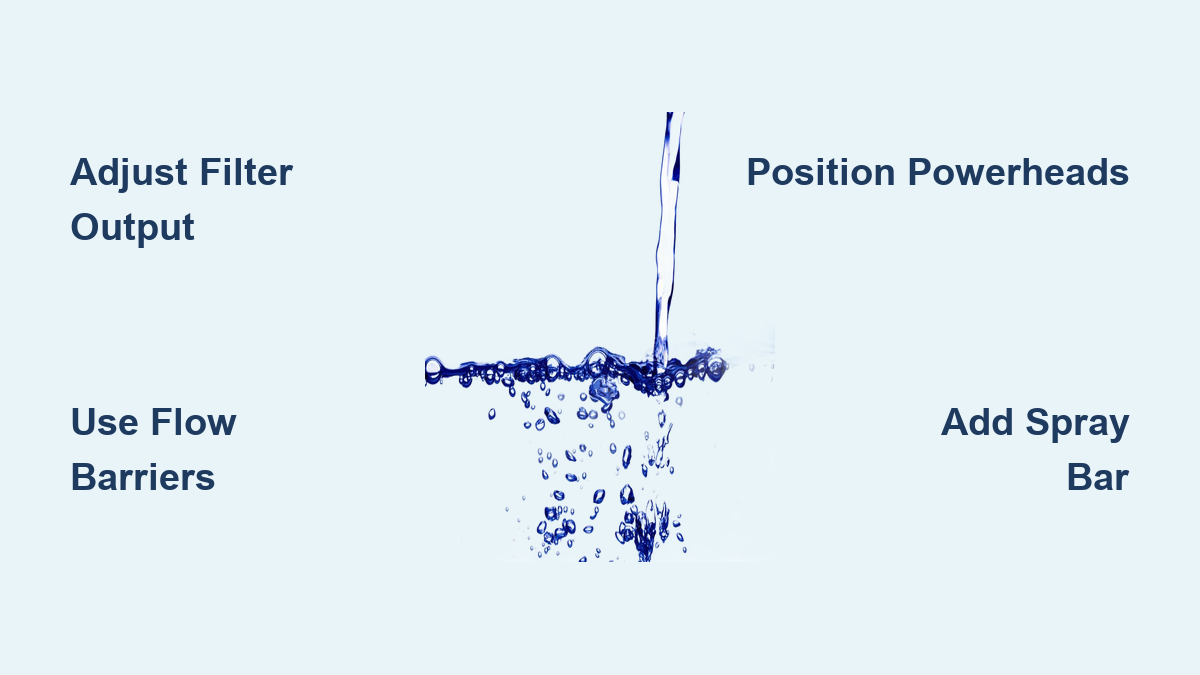
Most modern filters include flow control valves. Critical step: Never completely restrict flow below 3x tank turnover, as this compromises biological filtration. Instead, reduce output gradually while monitoring fish behavior. If your fish stop “hiding” from currents but debris still circulates properly, you’ve found the sweet spot. For filters without adjustment, wrap filter media around the intake tube to naturally reduce flow rate by 20-30%.
Positioning Inlets and Outlets for Natural Current Patterns
Angle your filter output upward at 45 degrees to create surface agitation for gas exchange while directing the main flow horizontally across the tank’s width. This creates a circular current pattern that prevents dead zones without strong directional flow. For canister filters, position the outflow near the water surface and intake near the substrate to establish vertical water movement.
Using Decor and Hardscape to Break Flow Naturally
Place driftwood, rocks, or broad-leaf plants directly in front of your filter’s output to split the current into smaller, multidirectional streams. Pro technique: Create a “flow barrier” using tall plants like Vallisneria on the filter’s downstream side—this diffuses currents while providing shelter for timid fish. Avoid blocking more than 50% of the output to maintain adequate circulation.
Adding a Powerhead Strategically for Dead Zone Elimination
Position powerheads in low-flow areas (typically tank corners) pointing toward your main filter’s intake. This creates a closed-loop circulation that eliminates dead spots without creating overpowering currents. Start at the lowest setting and increase only until debris stops accumulating. For planted tanks, angle the powerhead upward to create gentle surface movement without disturbing substrate.
Adding Natural Flow Diffusers for Instant Results
Immediate fix: Cover your filter output with a coarse sponge pre-filter ($3-$5). The sponge breaks the single jet into hundreds of gentle streams while adding mechanical filtration. For canister filters, attach a spray bar ($10-$20) that distributes flow evenly across the tank’s back panel. DIY alternative: drill 1/8″ holes every inch along a length of PVC pipe connected to your filter output.
3 Emergency Fixes for Fish Struggling Against Currents
Fish Swimming Against the Current: Quick Relief Tactics
If your fish are pinned against tank walls or hiding constantly, immediately reduce filter flow by 30-50%. For hang-on-back filters, lower the water level slightly below the intake to decrease flow rate. Critical warning: Never turn off filtration completely—even temporary shutdowns can crash your nitrogen cycle. In emergencies, add temporary flow barriers using acrylic sheets positioned strategically to create calm zones.
Dead Spots and Debris Accumulation: Targeted Solutions
For persistent dead zones, place a small air stone ($5) directly in the problem area. The rising bubbles create upward water movement that prevents debris accumulation. Better yet, position a nano powerhead (like the Nicrew NP-100) to create cross-currents that sweep debris toward your main filter intake. Pro tip: Angle the powerhead toward the tank wall opposite the dead zone to create rebound currents that cover more area.
Excessive Bubbles and Surface Agitation: Calming Choppy Water
If your surface looks like a boiling pot, your filter output is too strong or poorly positioned. For hang-on-back filters, attach a piece of foam to the waterfall section to break up the cascade. With canister filters, submerge the spray bar deeper or angle outputs downward slightly. Critical adjustment: Reduce surface agitation only in tanks without CO2 injection—adequate surface movement remains essential for oxygen exchange in most setups.
Monthly Flow Check: Preventing Clogs Before They Harm Your Tank
Flow rates decrease by 30-50% as filters clog. Monthly maintenance routine:
1. Rinse mechanical media in old tank water (never tap water)
2. Check impeller for debris every 2 weeks
3. Trim plants growing near filter intakes
4. Reassess flow patterns after any tank modification
Pro tip: Keep a flow meter ($10) to track GPH changes over time—sudden drops indicate impeller problems before fish show stress symptoms.
Mastering water flow diffusion transforms your aquarium from a survival environment to a thriving ecosystem. By implementing these techniques, you’ll create varied current patterns that support natural behaviors while maintaining optimal water quality. Remember that flow needs change as your tank matures—reassess monthly by observing fish behavior and debris patterns. With proper diffusion, you’ll notice immediate improvements: fish resting comfortably instead of fighting currents, plants growing vigorously without damage, and clearer water from more efficient waste removal. The secret to a truly healthy aquarium isn’t maximum flow—it’s strategically diffused flow that serves every inhabitant’s needs.