10 Gallon Saltwater Aquarium Setup (2026 Guide)
You’ve dreamed of bringing a vibrant piece of the ocean into your home but assumed space limitations ruled out a saltwater tank. A 10-gallon saltwater aquarium setup proves you wrong—it’s the perfect nano reef entry point for apartment dwellers and beginners. Yet this compact ecosystem demands surgical precision: unstable parameters can kill livestock within hours due to the tiny water volume. I’ve seen countless hobbyists rush into this project only to face algae explosions and mysterious livestock deaths within weeks. This guide cuts through the confusion with battle-tested strategies to transform your miniature ocean from a ticking time bomb into a thriving micro-reef. You’ll learn exactly which equipment prevents disasters, how to cycle properly without killing everything, and why your dream clownfish will doom this tank.
Why 90% of 10-Gallon Saltwater Tanks Fail Within 30 Days
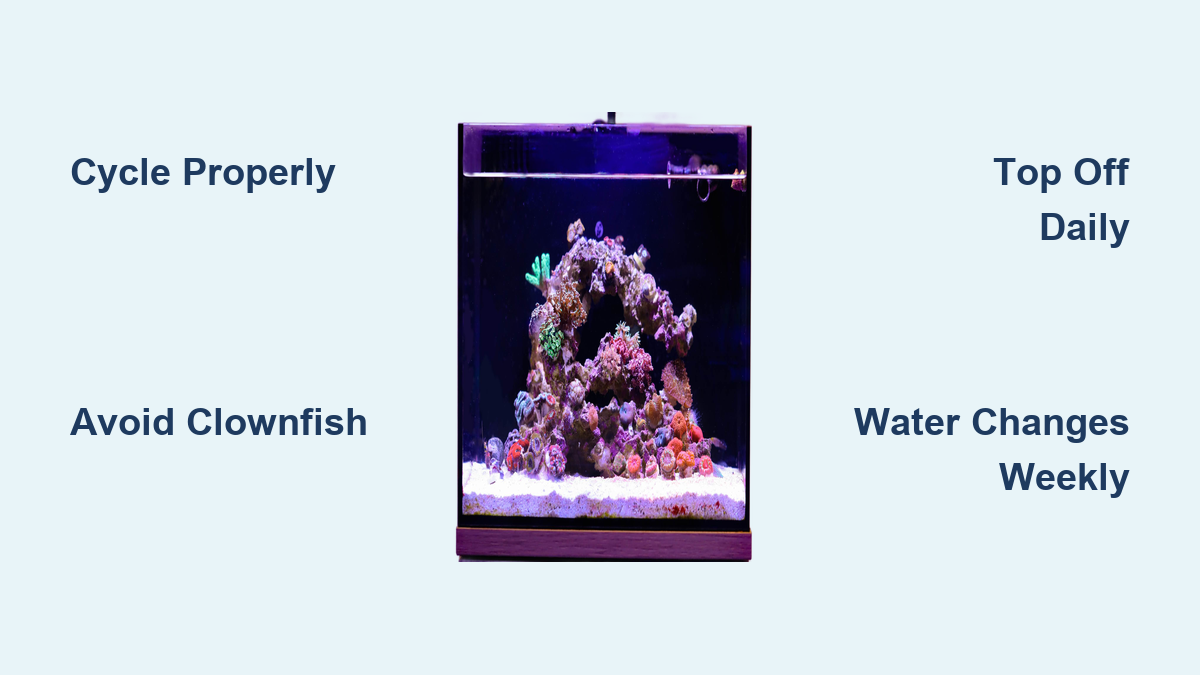
The brutal truth about nano reefs? They’re unforgiving chemistry labs masquerading as aquariums. When evaporation shifts salinity by 0.002 overnight or a single overfed shrimp spikes ammonia, your entire ecosystem hangs by a thread. Most failures trace back to three critical mistakes: skipping the nitrogen cycle to “just see results,” cramming in popular fish like clownfish that outgrow the space, and underestimating daily maintenance. Your 10-gallon saltwater aquarium setup requires military-grade discipline—weekly 20% water changes aren’t optional, and that RODI top-off bottle better live next to your coffee maker. Without these non-negotiables, you’re not creating a reef; you’re running a livestock funeral home.
Skipping the Nitrogen Cycle: The #1 Killer
Rushing past the 4-8 week cycling process is like building a house on quicksand. When beginners add livestock to uncycled tanks, invisible ammonia spikes cook fish gills within days. Here’s how to cycle correctly:
1. Fill your tank with saltwater mixed to 1.025 specific gravity using RODI water and marine salt
2. Dose pure ammonium chloride to hit 2-3 ppm (never use fish food or raw shrimp!)
3. Test daily until your tank processes 2-3 ppm ammonia down to 0 ppm ammonia and 0 ppm nitrite within 24 hours
Critical visual cue: Live rock should develop a thin biofilm during cycling—don’t scrub it off! This slime coat houses your future beneficial bacteria army.
Choosing Lethal Livestock: Clownfish and Other Nightmares
That adorable clownfish in the pet store? It’s a death sentence for your 10-gallon saltwater aquarium setup. These fish need 20+ gallons minimum when mature, and their territorial aggression turns nano tanks into war zones. Safe alternatives that won’t outgrow your tank:
– Invertebrates: Sexy shrimp colonies, pom-pom crabs, and micro brittle stars
– Fish: Only single, tiny gobies like neon blue Eviotas or red-headed Trimmas
– Corals: Mushroom corals, zoanthids, and leather corals (avoid aggressive LPS like hammers)
Pro tip: Your clean-up crew (Nassarius snails, ceriths) will be more fascinating than any fish—watch them hunt detritus like miniature predators.
Filtration, Flow, and Lighting: Your Nano Reef’s Lifeline

Forget canister filters—they become toxic detritus traps in 10-gallon systems. Your survival hinges on three precise elements working in concert.
Water Flow: Preventing Deadly Dead Zones
Stagnant pockets in nano tanks become algae breeding grounds and oxygen deserts. You need 200-300 GPH total flow (20-30x tank volume) with chaotic cross-currents. Action plan:
– Install two nano wavemakers (like Jebao NP2s) on opposite corners
– Angle them to create a “gyre” flow pattern that lifts sand beds
– Test for dead spots: Sprinkle fish food—if it settles anywhere, reposition pumps
LED Lighting: Coral Growth Without Meltdowns

Shallow 10-gallon tanks need moderate-high intensity but minimal heat output. Critical specs:
– Full-spectrum LEDs with 10,000K white + 420nm blue channels
– Minimum 50-70 PAR at sandbed (use a PAR meter app)
– 8-hour photoperiod on a timer—no fancy sunrise/sunset needed
Warning: T5 or metal halides will cook your tank; stick with nano-specific LEDs like the Fluval Flex.
Your Non-Negotiable 10-Gallon Maintenance Schedule

Consistency beats complexity in nano reefs. Skip one water change, and nitrates will spike to toxic levels before you notice.
Daily Top-Off: The Salinity Stabilizer
This single action prevents 80% of crashes. Evaporation concentrates salt rapidly in small volumes:
– Top off with RODI water every morning before work
– Maintain a visible fill line on the tank wall
– Pro move: Use an automatic top-off (ATO) system with a 1-gallon reservoir
Weekly Water Change Protocol
Forget “when I remember”—schedule it like a dentist appointment:
1. Prepare new saltwater 24 hours ahead (match 78-80°F temp and 1.025 SG)
2. Siphon 2 gallons while vacuuming sand (avoid deep beds)
3. Add new water slowly over 30 minutes to prevent shock
Why this works: Weekly 20% changes export nitrates/phosphates better than any protein skimmer in nano tanks.
Fixing 10-Gallon Tank Crises: Algae, Swings, and Dead Spots
When disaster strikes your miniature ocean, speed saves lives.
Cyanobacteria Explosion Fix
That slimy red algae means nutrient overload:
– Immediate action: Reduce feeding to 3 tiny pinches 3x/week
– Perform two 25% water changes 48 hours apart
– Add a Chaetomorpha algae reactor (1 cup macroalgae)
– Never skip: Clean filter socks in tank water—not tap!
Temperature Spike Emergency
A stuck heater can cook your tank in hours:
1. Unplug all equipment immediately
2. Float sealed ice packs in a clean container (never direct ice!)
3. Replace 1 gallon of water with pre-cooled RODI water
4. Install an Inkbird heater controller as permanent insurance
The Truth About Clownfish in 10-Gallon Tanks
Let’s bury this myth forever: No clownfish belongs in a 10-gallon saltwater aquarium setup. Popular “nano” species like ocellaris clowns grow to 3+ inches and become violently territorial in confined spaces. Within 6 months, they’ll:
– Chase all tankmates into corners
– Refuse to eat due to stress
– Trigger fatal ammonia spikes from aggression
Better path: Start with a sexy shrimp colony—they’re more active, colorful, and actually thrive in nano volumes. Save clownfish for 30+ gallon systems where they have space to establish territories.
Your 10-gallon saltwater aquarium setup isn’t just a decoration—it’s a high-stakes balancing act that demands respect. But nail the discipline of daily top-offs, weekly water changes, and smart stocking, and you’ll unlock an astonishingly vibrant micro-reef. I’ve watched nano tanks with thriving mushroom coral gardens and bustling shrimp colonies outlast poorly maintained 55-gallon systems. The secret? Treat your miniature ocean like the precision ecosystem it is. Start with invertebrates, cycle religiously, and never compromise on water changes. In six months, you’ll have a living jewel box that rewards your rigor with daily discoveries—a testament to what’s possible when you master the art of small-scale reefing. Now go mix that first batch of saltwater; your ocean journey starts today.