10 Gallon Aquarium Dimensions Guide
If you’re setting up your first 10-gallon aquarium or replacing an existing one, knowing the precise measurements is critical for proper placement, stand selection, and fish health. The standard 10-gallon tank dimensions of 20 inches long by 10 inches wide by 12 inches high might seem straightforward, but these measurements impact everything from your fish’s living space to the structural requirements of your stand. Many beginners make costly mistakes by not understanding that the actual water volume is less than 10 gallons and that a filled tank weighs nearly 100 pounds.
Your 10-gallon aquarium measurements determine more than just physical space—they affect water chemistry stability, fish stocking capacity, and even your home’s safety. When you purchase what’s marketed as a “10-gallon” tank, you’re actually getting a container with specific external dimensions that hold slightly more than 10 gallons when empty, but significantly less when set up with substrate and decorations. Understanding these precise 10 gallon aquarium measurements helps you avoid common setup errors that lead to unstable water conditions and unhappy fish.
This guide provides the exact dimensions you need to know, explains why they matter for your specific setup, and gives you practical advice for choosing the right location and equipment based on your tank’s true measurements.
Standard 10-Gallon Tank Dimensions: 20″x10″x12″ Explained
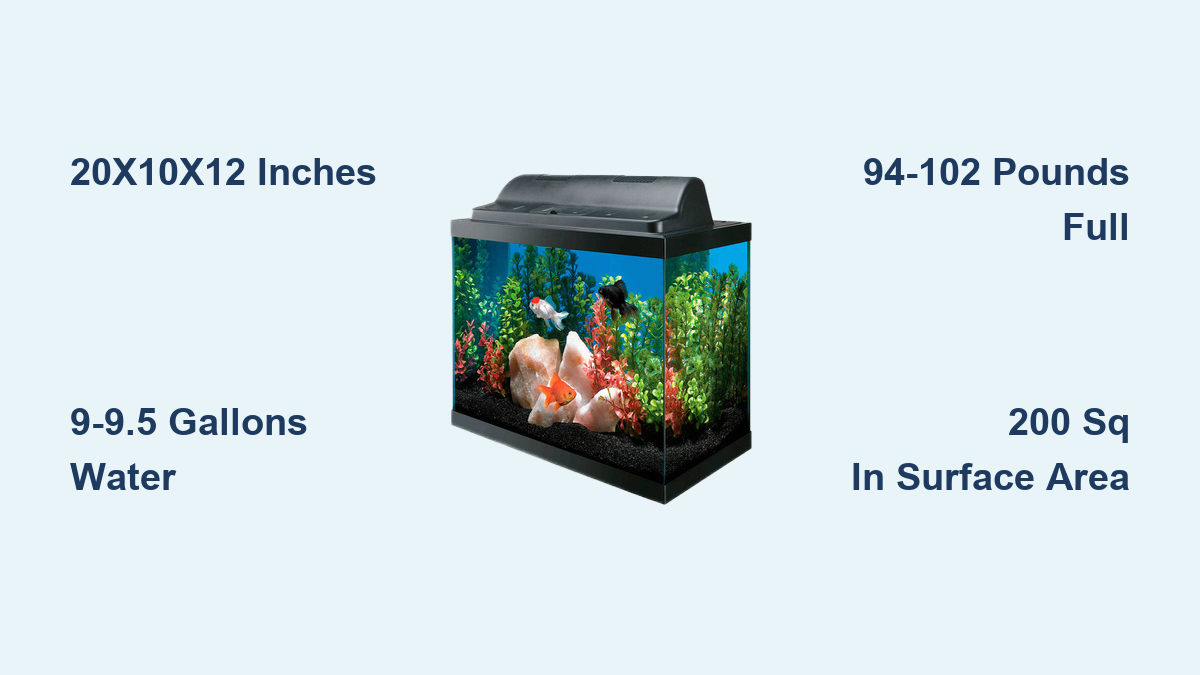
Your standard rectangular 10-gallon aquarium follows the industry measurement standard of 20 inches in length, 10 inches in width (or depth), and 12 inches in height. These external dimensions create a tank that holds approximately 10.39 gallons when completely filled to the brim, calculated by multiplying 20 × 10 × 12 = 2,400 cubic inches and dividing by 231 (the number of cubic inches in a US gallon).
Manufacturer-Specific 10-Gallon Measurements You Must Check
While 20″x10″x12″ represents the standard, always verify your specific model’s measurements before purchase. Marineland’s 10-gallon tank measures precisely 20-7/32 inches long by 10-7/32 inches wide by 12-3/16 inches high, while Aqueon models typically run 20.25″x10.5″x12.63″. Top Fin (Petco’s brand) generally adheres to the 20″x10″x12″ standard. These small variations matter when fitting your tank into a specific space or ordering custom lids.
Why Your 10-Gallon Tank Holds Only 9-9.5 Usable Gallons
Don’t be surprised when your “10-gallon” tank contains less water than expected—the actual operational volume is typically 9-9.5 gallons due to displacement. Substrate (1-2 inches deep) displaces about 1 gallon, while decorations and equipment account for another half-gallon. When setting up your 10-gallon aquarium, remember the water level should sit 1-2 inches below the top rim for proper gas exchange and to prevent splashing. This displacement means your fish live in significantly less water than the tank’s rated capacity, affecting your stocking decisions and water parameter stability.
10-Gallon Tank Weight: Why Empty vs. Filled Measurements Matter for Safety
:strip_icc()/SPR_1380694-aquarium-sizes-and-weights-1bf7f0fbbfd44d6caca00657f70a33d3.png)
Your empty 10-gallon aquarium weighs approximately 10.8 pounds, but this number dramatically increases once filled. Water alone adds 83.3 pounds (10 gallons × 8.34 lbs/gallon), bringing the total to 94 pounds before adding substrate, decorations, and equipment. This critical weight measurement impacts everything from stand selection to floor safety.
Weight Breakdown Every 10-Gallon Tank Owner Must Know
Understanding the complete weight distribution prevents dangerous setup mistakes:
– Empty glass tank: 10.8 pounds
– 10 gallons of water: 83.3 pounds
– Substrate (1-2 inch layer): 10-15 pounds
– Decorations and equipment: 5-10 pounds
– Total operational weight: 94-102 pounds
Never place your 10-gallon tank on furniture not rated for at least 100 pounds. Particle board surfaces are especially dangerous as they weaken when exposed to moisture. Always use a dedicated aquarium stand or verify your furniture’s weight capacity exceeds 1.5 times your tank’s total weight.
Choosing the Right Stand for Your 20″x10″ 10-Gallon Aquarium
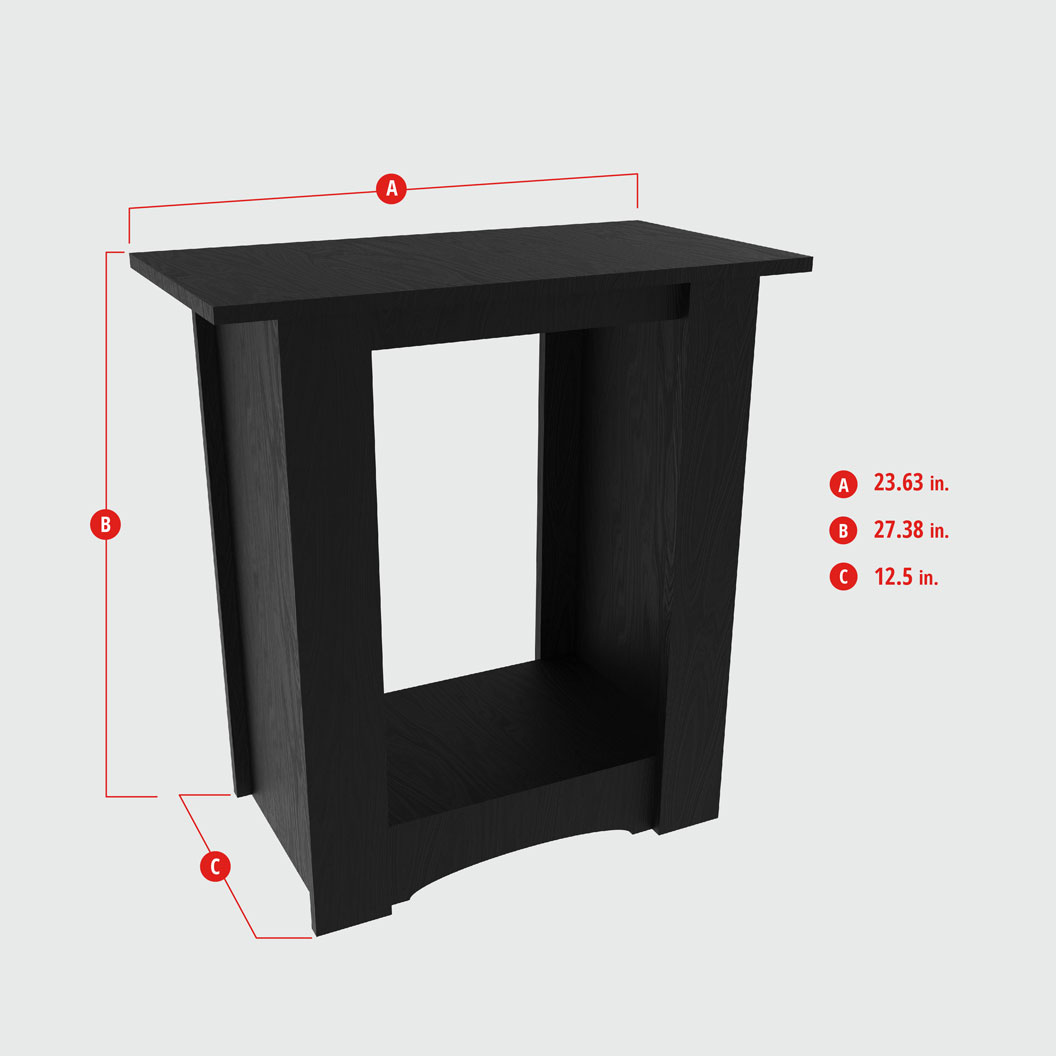
Your tank’s 20-inch length and 10-inch width require specific stand dimensions for safe support. The minimum recommended surface area is 24 inches deep by 14 inches wide—providing a 2-inch buffer around the tank’s footprint. This extra space prevents accidental bumps and allows room for equipment.
Stand Leveling: A Non-Negotiable Measurement Requirement
Leveling your stand is critical for tank integrity—uneven surfaces create dangerous stress points in the glass. Use a 4-foot level to ensure your stand has no more than 1/16 inch variance across its surface. Even slight tilting can cause leaks or catastrophic failure over time. Place your level horizontally and vertically across the stand surface before setting up your 10-gallon aquarium, and use quality shims if needed to achieve perfect levelness.
Setting Up Your 10-Gallon Tank: Equipment Based on Exact Dimensions
Your tank’s 200-square-inch surface area (20″ × 10″) directly impacts equipment selection. This measurement determines oxygen exchange capacity, which affects your fish’s health and your filter requirements.
Filter Selection for Standard 10-Gallon Measurements
For a standard 20″x10″x12″ tank, choose a filter rated for 100-200 gallons per hour (GPH). This provides the recommended 10-20x turnover rate for a 10-gallon aquarium. Hang-on-back filters work well for this size, but ensure the intake isn’t obstructed by decorations that might crowd your limited 200-square-inch footprint. Position the filter outlet to create gentle surface agitation across the entire water surface for optimal gas exchange.
Substrate Amounts Based on Your Tank’s Width and Depth
With your tank’s 10-inch width, calculate substrate needs precisely:
– For 1-inch depth: 10-15 pounds of gravel or 15-20 pounds of sand
– For 2-inch depth: 20-25 pounds of gravel or 25-35 pounds of sand
Measure your substrate depth with a ruler during setup—exceeding 2 inches in a 10-gallon tank can create anaerobic pockets that release harmful gases into your water.
Best Fish for a 10-Gallon Tank: Matching Stocking to Surface Area
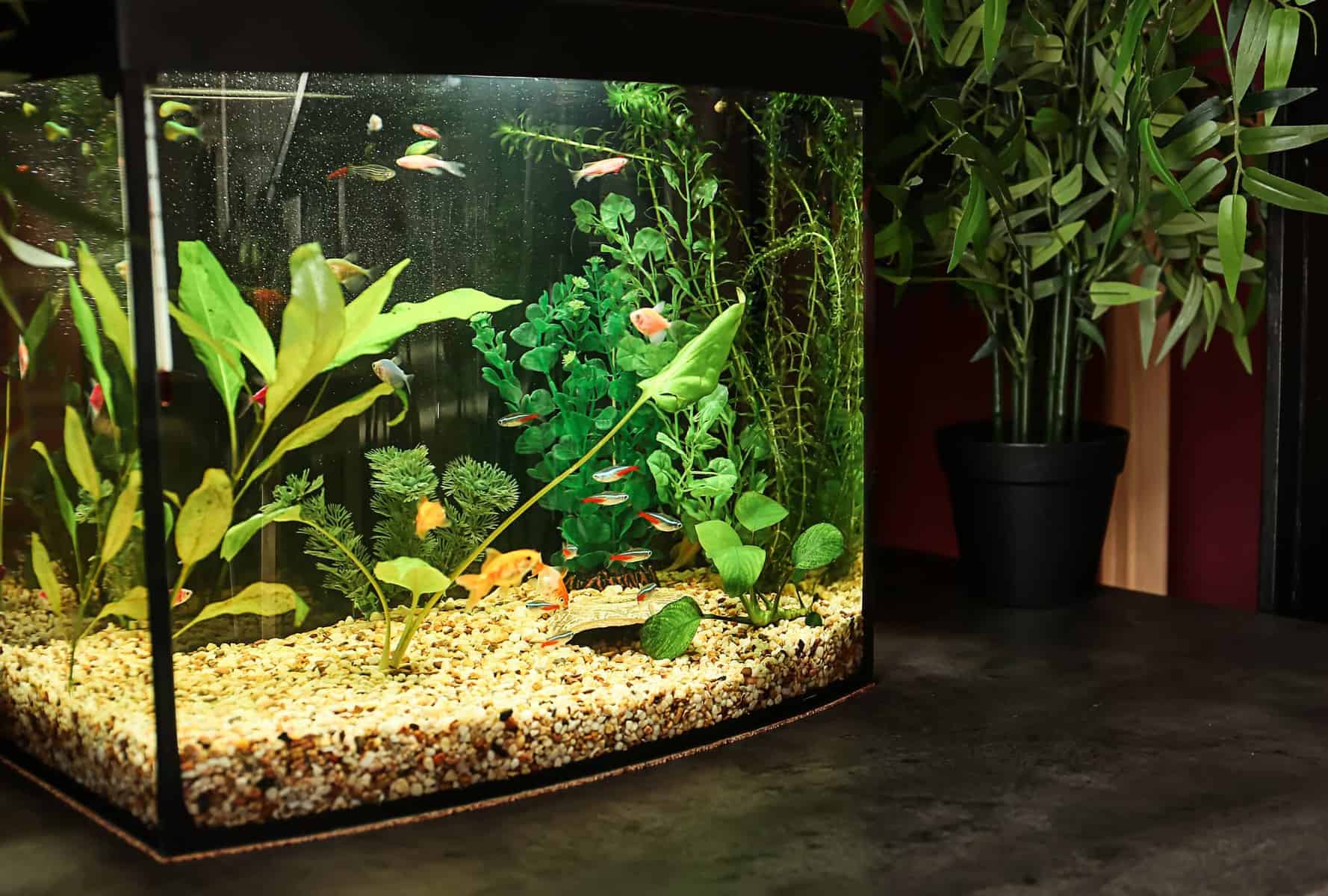
Your tank’s 200-square-inch surface area is more important than total volume when determining fish compatibility. This measurement directly affects oxygen availability—critical for fish health in smaller tanks.
Surface Area Stocking Guidelines for 10-Gallon Measurements
Focus on fish that utilize different water columns to maximize your 200-square-inch surface:
– Top dwellers: Small hatchetfish (2-3 specimens)
– Mid-water swimmers: 6-8 chili rasboras or ember tetras
– Bottom cleaners: 6-8 pygmy corydoras
Avoid the “inch per gallon” myth—stocking should consider adult size, activity level, and waste production. A single betta requires the same water quality management as six small tetras in your 10-gallon setup.
Avoid These 10-Gallon Tank Placement Mistakes Based on Dimensions
Many beginners place their 10-gallon aquariums without considering how dimensions interact with environmental factors. The tank’s 12-inch height makes temperature fluctuations more pronounced than in taller tanks, while the 20-inch length increases vulnerability to direct sunlight exposure.
Critical Placement Measurements You’re Overlooking
Position your tank at least:
– 24 inches away from heating/cooling vents
– 36 inches from direct sunlight windows
– 12 inches from walls for equipment access
The 12-inch height means temperature changes happen faster than in deeper tanks—place your thermometer away from the heater to get an accurate average reading across your water column.
Verifying Your 10-Gallon Tank’s Actual Measurements
Never assume your tank matches standard dimensions—always verify with these steps:
- Measure external dimensions with a tape measure (length × width × height in inches)
- Calculate theoretical volume: (L × W × H) ÷ 231 = gallons
- For actual water volume, fill to 1-2 inches below rim and measure
- Compare with manufacturer specifications
This verification process prevents stocking and equipment errors based on incorrect assumptions about your specific 10-gallon aquarium measurements.
Final Note: Knowing your exact 10-gallon aquarium measurements prevents common setup mistakes that lead to unstable water conditions and fish stress. Remember that your tank’s true water volume is less than 10 gallons, its filled weight exceeds 90 pounds, and its 200-square-inch surface area directly impacts fish health. Always verify your specific model’s dimensions before setup, ensure your stand can handle the full weight, and stock based on actual water volume rather than the “10-gallon” label. Proper attention to these measurements creates a stable, healthy environment for your aquatic pets and prevents costly mistakes down the line.