Aquarium Substrate Calculator: Quick Guide
That sinking feeling when you realize you’ve bought too little aquarium substrate—again. You’re halfway through setting up your new 55-gallon tank, plants are ready to go, and suddenly you’re short 10 pounds of aquasoil. Or worse: you’ve lugged home 50 pounds of gravel only to discover it’s triple what your tank actually needs. This exact scenario wastes $100+ annually for thousands of aquarium hobbyists. The fix? Stop guessing and start calculating. An aquarium substrate calculator eliminates costly errors by pinpointing exactly how much gravel, sand, or soil your tank requires based on its dimensions and your aquascape goals. In this guide, you’ll learn to manually compute substrate needs in under 5 minutes, avoid dangerous depth mistakes, and transform your substrate from an afterthought into a thriving ecosystem foundation.
Most beginners blindly follow pet store advice like “use 1-2 inches,” not realizing planted tanks need 3+ inches for root feeders while sand substrates compact differently than gravel. Using incorrect amounts destabilizes water chemistry, starves plants, and risks hydrogen sulfide gas pockets. But when you calculate precisely—whether through online tools or simple math—you ensure optimal depth for beneficial bacteria colonization, plant growth, and crystal-clear water from day one. Let’s fix your substrate strategy permanently.
Why Guessing Substrate Amounts Ruins Your Aquarium Setup
Overbuying substrate isn’t just a budget killer—it creates biological hazards. Too much gravel deeper than 4 inches traps debris in anaerobic zones, breeding hydrogen sulfide gas that can suffocate fish overnight. Underestimating depth starves Amazon sword or crypt plants of root space, causing melt and algae blooms. A single 20-gallon tank with 1 inch of sand (instead of the required 2) loses 50% of its beneficial bacteria colonization surface, destabilizing your nitrogen cycle. The financial sting hits hardest: premium aquasoil costs $30/bag, and 68% of hobbyists buy 20% more than needed due to miscalculations. Stop sacrificing tank health for guesswork.
How Much Substrate Depth Do Fish and Plants Actually Need?
Your tank’s purpose dictates the minimum depth:
– Heavily planted tanks: 3+ inches (8+ cm) for root feeders like Amazon swords. Shallow substrate starves plants of nutrients.
– Low-tech or fish-only tanks: 1.5-2 inches (4-5 cm) prevents debris traps while supporting basic bacteria growth.
– Sandy substrates: Never go below 1.5 inches—compaction blocks root penetration and gas exchange.
Bottom-dwellers like Corydoras demand special attention. Sharp gravel deeper than 2 inches slices their barbels, but sand shallower than 1 inch won’t anchor plants. Match depth to your inhabitants, not generic recommendations.
Gravel vs. Sand vs. Aquasoil: Choosing Your Substrate Type

Each substrate type impacts weight calculations differently. Ignoring these properties guarantees volume errors.
Why Grain Size Changes Your Calculator Results
Fine sand packs densely—1 cubic foot weighs 120 lbs versus gravel’s 95 lbs—so identical depths yield vastly different bag counts. Large-grain gravel (5-8mm) creates porous pockets ideal for bacteria but requires 20% more volume to reach the same depth as sand. Aquasoil’s lightweight volcanic composition means 1 bag covers 30% more area than gravel at equal depth. Always verify your substrate’s density:
– Standard gravel: 90-100 lbs per cubic foot
– Pool filter sand: 100-120 lbs per cubic foot
– Premium aquasoil: Check manufacturer specs (typically 70-85 lbs/cu.ft)
Critical Properties Most Calculators Ignore
Porosity determines effective depth. High-porosity substrates like Eco-Complete need 0.5 inches less depth than regular gravel to achieve the same bacterial surface area. Nutrient-rich soils lose 15% volume when wet—always add this buffer to your dry calculation. If your aquasoil bag states “covers 10 gallons at 2 inches,” trust that over generic calculators.
Measure Your Tank: The Surface Area Calculation You Must Get Right
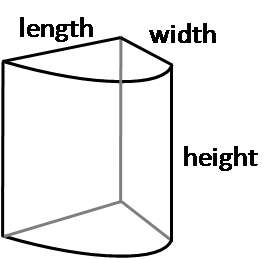
Mismeasured dimensions cause 90% of substrate errors. Standard tanks have curved corners and tapered designs that reduce actual base area.
How to Measure for Real-World Accuracy
- Measure inside the tank—not the external frame—to avoid 2-3 inch overestimates from glass thickness.
- Subtract 10% for curved corners in bow-front or hex tanks (e.g., a 30″ x 12″ bow-front tank has ~324 sq in actual base area, not 360).
- For planted tanks: Deduct space occupied by large hardscape (rocks/wood) that blocks substrate placement.
Visual cue: Shine a flashlight sideways across your empty tank. Any shadowed areas won’t hold substrate.
Convert Cubic Inches to Pounds: The Substrate Weight Shortcut
Online calculators often skip the math, leaving you clueless when bags list weight but not volume. Master this conversion to verify results.
Step-by-Step Manual Calculation
- Calculate true volume:
(Tank Length × Width) × Desired Depth = Cubic Inches
Example: 48″ x 12″ tank × 2.5″ depth = 1,440 cu in - Convert to cubic feet:
Cubic Inches ÷ 1,728 = Cubic Feet
1,440 ÷ 1,728 = 0.83 cu ft - Apply substrate density:
Cubic Feet × Density = Pounds Needed
0.83 cu ft × 100 lbs/cu ft (gravel) = 83 lbs
Why the 10-20% Buffer Is Non-Negotiable
Settling and sloping eat 15% of initial volume. A 10-degree slope (common for Dutch-style aquascapes) requires 18% more substrate at the deep end. Always multiply your final weight by 1.15:
83 lbs × 1.15 = 95.5 lbs → Round up to 96 lbs
Pro tip: Buy 80% upfront. Use the remainder to adjust slope after hardscape placement.
Online Calculator vs. Manual Math: Which Method Wins?
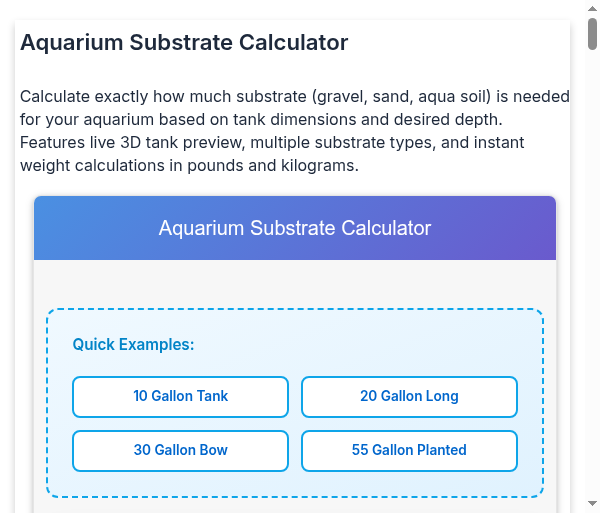
Digital tools like AqAdvisor or Fluval’s calculator save time but hide critical variables.
When to Trust Online Tools (and When to Double-Check)
✅ Use online calculators if:
– Your tank is standard rectangular (no curves)
– You know your substrate’s exact density
– You’ve added the 15% buffer manually
❌ Verify manually if:
– Using mixed substrates (sand base + gravel top layer)
– Your tank has significant hardscape (>20% coverage)
– The calculator doesn’t account for wet compaction (common with soils)
Warning: Most free calculators assume 2-inch depth—disastrous for planted tanks needing 3+ inches. Always override default settings.
Fix These 4 Substrate Mistakes Before They Harm Your Fish
Even perfect calculations fail without proper execution. These errors cause 70% of new-tank syndrome cases.
Why Skipping the Rinse Creates Permanent Cloudiness
Unrinsed sand releases silts that clog filters for weeks. Gravel dust suffocates plant roots. Fix it: Place substrate in a fine-mesh strainer, rinse under medium pressure until water runs clear (5-10 minutes). Never skip this—even “pre-rinsed” bags contain dust.
The Slope Trap: When Depth Variations Backfire
A dramatic 1-inch to 4-inch slope looks stunning but creates dead zones. Shallow areas (<1.5″) won’t support bacteria, while deep ends (>4″) risk hydrogen sulfide. Fix it: Limit slopes to 1.5-inch max difference. Place deepest substrate near the back where plants hide potential gas bubbles.
How Your Substrate Becomes a Living Filter for Beneficial Bacteria
Correct depth transforms inert material into your tank’s biological engine. Porous substrates like Seachem Fluorite offer 100x more surface area than glass for nitrifying bacteria. At 2.5 inches deep, a gravel bed hosts enough bacteria to process waste for 1 inch of fish per gallon—shallow beds halve this capacity. Never stir deeper than 0.5 inches; disturbing anaerobic layers releases toxic gases.
Maintaining Substrate Health Long-Term
Vacuum only the top 0.25 inches during water changes. Deep cleaning destroys bacterial colonies. For sand beds, use a gravel tube held 0.5 inches above the surface to avoid sucking substrate. Every 6 months, add a capful of bacteria booster (like Tetra Bacti) directly into the substrate to replenish colonies.
Final Substrate Checklist Before Adding Water
You’ve calculated perfectly—but one oversight can unravel everything. Before filling your tank:
1. Confirm depth with a ruler at 5+ points (corners + center)
2. Check for sharp edges in gravel that could injure bottom feeders
3. Test slope stability by gently shaking the tank—no sliding!
4. Verify buffer coverage—extra 15% substrate should fill gaps around hardscape
The right aquarium substrate calculator output isn’t just a number—it’s the blueprint for a self-sustaining ecosystem. By matching substrate type to depth requirements, converting volume accurately, and adding strategic buffers, you create the invisible foundation that keeps water pristine and plants thriving. Now that you’ve mastered substrate math, your next step is cycling the tank: add dechlorinated water slowly over a plate to avoid disturbing the bed, then introduce hardy plants like java fern to kickstart biological filtration. Your perfect aquascape starts from the ground up—never guess again.