How to Make Aquarium Plant Fertilizer at Home
Tired of draining your wallet on commercial liquid fertilizers every month? You’re not alone. Aquascapers like Hanuman in Thailand pay premium prices just to keep their 90cm, 60cm, and 36cm planted tanks thriving—only to discover he could make his own for pennies using dry salts he already owned. If your bucephalandra or carpeting plants are stunted while your budget shrinks, this guide solves both problems. I’ll show you exactly how to make aquarium plant fertilizer using chemical-grade salts, avoiding toxic mistakes that cause algae blooms or shrimp deaths. By the end, you’ll confidently mix three stable solutions that deliver precise nutrients—no chemistry degree required.
Why Commercial Fertilizers Cost You 5x More Than Necessary
Most liquid fertilizers charge you for water weight and marketing, not nutrients. When Hanuman analyzed APT Complete (a popular Singaporean brand), he realized 95% of what he paid was packaging and shipping—not the actual potassium nitrate or iron chelates his plants needed. Dry salts cost pennies per dose: Potassium Nitrate (KNO₃) at $8/kg makes enough macro solution for 200+ doses in a 60cm tank. Crucially, commercial “all-in-one” formulas often include ammonia-based compounds like Monoammonium Phosphate—which releases toxic ammonia in stocked tanks. Your DIY mix eliminates this risk by using only nitrate-based nitrogen sources, keeping shrimp and fish safe while cutting costs by 80%.
Must-Wear Safety Gear Before Handling Dry Salts
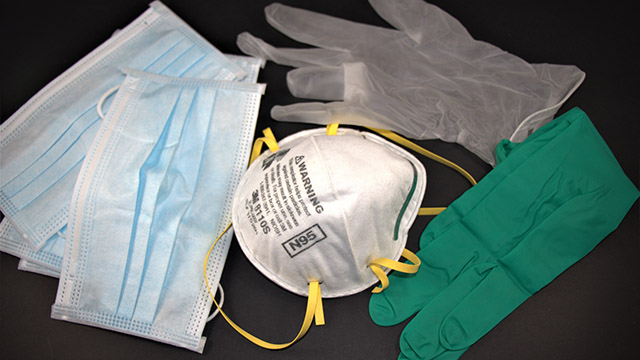
Never skip these precautions when making aquarium plant fertilizer: Wear nitrile gloves and an N95 dust mask while weighing powders—microscopic salt particles can irritate lungs. Work near an open window or use a fume hood, and keep pets and children out of the mixing area. Label every bottle immediately with permanent marker: “MACRO SOLUTION – 60g KNO₃ + 10g KH₂PO₄ per 500ml – KEEP OUT OF REACH OF CHILDREN.” Most critically, always start with half the recommended dose for your first week. Over-fertilizing causes explosive algae growth within 48 hours, while under-dosing only slows plant growth—which is easily fixed. If your tank develops green water after dosing, reduce the next dose by 25% immediately.
Exact Dry Salts List for Shrimp-Safe Fertilizer
Use this verified chemical list—no substitutions—to avoid toxicity. Hanuman had access to 13 compounds, but only 7 are essential for a safe, effective mix:
- Potassium Nitrate (KNO₃): Supplies nitrogen (NO₃⁻) and potassium (K⁺). Never substitute with Monoammonium Phosphate—it releases toxic ammonia.
- Monopotassium Phosphate (KH₂PO₄): Provides phosphorus (PO₄³⁻) and potassium.
- Potassium Sulfate (K₂SO₄): Boosts potassium without phosphorus.
- Magnesium Sulfate Heptahydrate (Epsom salts): Critical for chlorophyll production.
- Iron DTPA (Fe-DTPA 7%): Best iron chelate for pH 6.0–7.5 tanks.
- Manganese EDTA (Mn-EDTA 13%): Prevents “railroad” leaf striping.
- Sodium Molybdate (Mo 39.5%): Needed for nitrate processing.
Avoid copper chelates entirely if you keep shrimp or snails—even 0.05 ppm causes gill damage. Skip Boron and Zinc unless your tap water tests show deficiencies; excess causes leaf holes.
Why Three Separate Bottles Prevent Nutrient Lockout
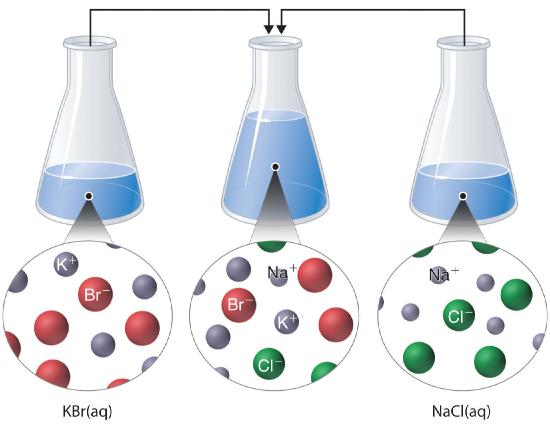
Combining all salts into one “all-in-one” solution causes dangerous precipitation. Potassium Nitrate and Monopotassium Phosphate will crystallize when mixed with Magnesium Sulfate, creating cloudy sludge that clogs dosing pumps. The three-bottle system solves this:
- Macro Bottle: Nitrogen, phosphorus, potassium sources
- Magnesium Bottle: Epsom salts only
- Trace Bottle: Iron + micronutrients
This prevents reactions like KNO₃ + KH₂PO₄ forming insoluble crystals. Each solution stays clear for 6+ months when stored properly. Never attempt an all-in-one mix—even acidifying with vinegar (as some suggest) risks unstable pH swings that kill plants.
How to Mix Macro Nutrients in 500ml Bottle
You’ll need: Digital scale (0.01g precision), 500ml glass bottle, distilled water.
- Weigh 60g Potassium Nitrate and 10g Monopotassium Phosphate into a dry container.
- Add 400ml distilled water (not tap water—minerals cause cloudiness).
- Swirl gently until crystals dissolve (5–10 minutes—do not shake).
- Top to 500ml mark with distilled water. Label: “MACRO – 5ml per 50L tank.”
Pro Tip: If solution clouds, discard it—this means tap water contaminants reacted with salts. Restart with distilled water.
Safe Magnesium Sulfate Solution for Soft Water Tanks
Soft water tanks (GH < 4) need extra magnesium for red plants like Rotala. This solution prevents yellowing leaves:
- Weigh 60g Epsom salts (MgSO₄·7H₂O) into container.
- Add 500ml distilled water. Swirl until clear (dissolves faster than macros).
- Label: “MAGNESIUM – 2ml per 20L weekly.”
Critical Check: If your tank has shrimp, skip this if GH > 6—excess magnesium stresses invertebrates.
Trace Element Mixing: Avoiding Shrimp-Killing Copper

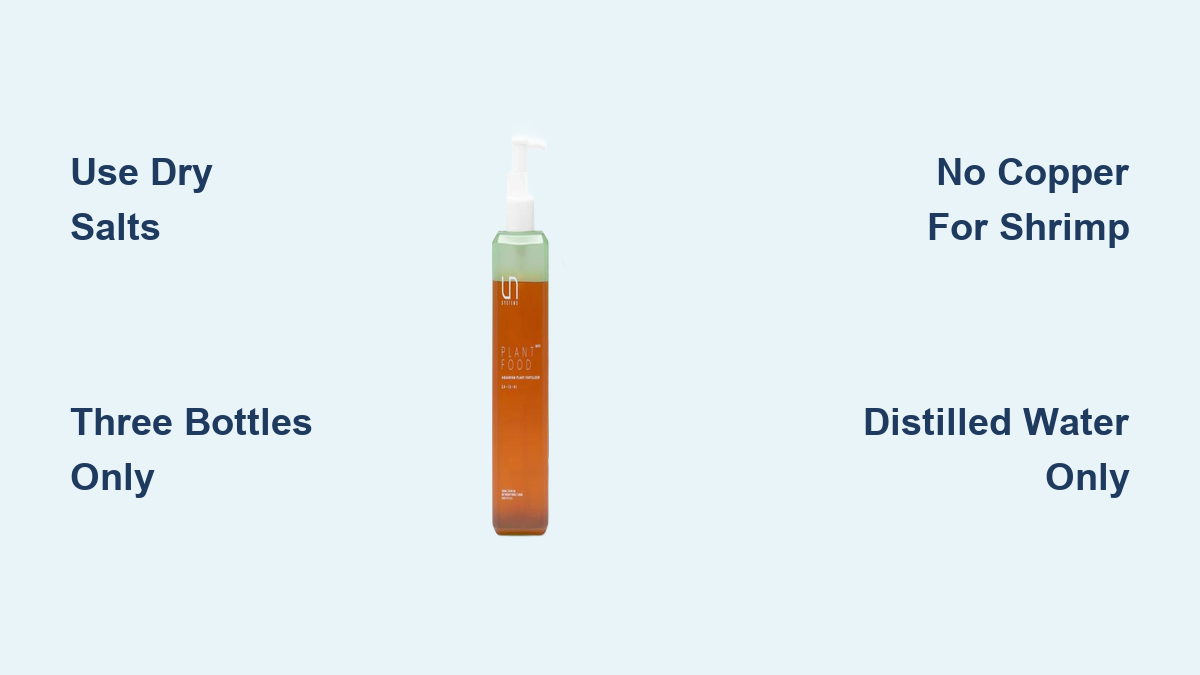
For fish-only tanks: Use TNC Trace powder (25g per 500ml distilled water). It contains safe copper levels (<0.1 ppm).
For shrimp/snail tanks: Omit copper entirely. Mix only:
– 3g Iron DTPA
– 0.5g Manganese EDTA
– 0.1g Sodium Molybdate
Dissolve in 500ml distilled water. Label: “TRACE – 3ml per 30L weekly – NO COPPER.”
Warning: Never use Copper Chelate (14% Cu) in shrimp tanks—even 0.02 ppm causes molting failure. If you accidentally add it, do a 70% water change immediately.
Weekly Dosage Schedule for 90cm, 60cm, 36cm Tanks

Follow this EI (Estimative Index) schedule—based on Hanuman’s heavily planted tanks—to avoid deficiencies:
| Tank Size | Macro (ml) | Mg (ml) | Trace (ml) | Frequency |
|---|---|---|---|---|
| 90cm (200L) | 20 | 8 | 12 | Mon, Wed, Fri |
| 60cm (80L) | 8 | 3 | 5 | Mon, Wed, Fri |
| 36cm (30L) | 3 | 1 | 2 | Mon, Wed, Fri |
Always pair dosing with water changes:
– Sundays: 50% water change → dose full amounts
– Mondays: Rest day (observe for algae)
– Tuesdays: Macro + Trace only
– Wednesdays: Trace only
– Repeat through Saturday
If black beard algae appears, skip macros for 3 days. If new leaves yellow, increase iron dose by 20%.
Fix Cloudy Fertilizer Solutions in 2 Minutes
Cloudiness means tap water minerals reacted with salts—never dose this into your tank. Fix immediately:
1. Pour cloudy solution through a coffee filter into clean container.
2. Add 10ml distilled water per 100ml solution.
3. Swirl gently—cloudiness should clear within 60 seconds.
4. If persistent, discard and restart with 100% distilled water.
Pro Tip: Store distilled water in a sealed container—exposure to air introduces CO₂ that lowers pH and causes precipitation.
Storage Rules That Prevent Nutrient Degradation
Light and air destroy iron chelates within weeks. Follow these rules:
– Use amber glass bottles (blocks UV light)—never clear plastic.
– Fill bottles to the brim to minimize air exposure.
– Store in a dark cabinet (not under aquarium lights).
– Discard after 6 months—old solutions lose potency.
Critical Test: Shake your trace bottle. If it smells like rotten eggs, manganese has oxidized—discard immediately and remake.
When to Dose Less for Slow-Growing Tanks
Bucephalandra and anubias need 50% less fertilizer than carpeting plants. For tanks like Hanuman’s 60cm buce tank:
– Halve macro doses (e.g., 4ml instead of 8ml for 80L)
– Skip magnesium entirely (buce thrives in soft water)
– Dose traces only once weekly
Yellow tips on slow growers mean over-fertilization—not deficiency. Reduce doses by 30% if new leaves have brown edges.
Making your own aquarium plant fertilizer puts you in control of plant health while slashing costs. Start with the three-bottle system using distilled water, skip copper if you keep shrimp, and always dose after water changes. Within two weeks, you’ll see faster growth in demanding plants like HC Cuba—and your wallet will thank you. For troubleshooting, test your tap water’s GH/KH first—this reveals which nutrients you truly need to add. Ready to go deeper? Calculate exact ppm doses using Zorfox’s free aquarium calculator (mentioned by experts in the UKAPS forum) to tailor nutrients to your specific tank. Your plants aren’t starving—they’re waiting for the right building blocks. Now you know exactly how to deliver them.