How to Fix GH and KH in Aquarium Water
Your neon tetras are hiding, your angelfish fins are clamped, and mysterious white crust is forming on your filter intake. These are classic signs your aquarium’s GH (General Hardness) and KH (Carbonate Hardness) are dangerously out of balance. When these critical water parameters drift too high or too low, they destabilize pH, disrupt fish osmoregulation, and can cause mass die-offs within days. This guide cuts through the confusion with actionable methods to fix GH and KH in your aquarium using proven techniques backed by water chemistry science. You’ll learn exactly how to diagnose imbalances, choose the right correction method for your fish species, and make changes safely without shocking your delicate ecosystem.
Why Your Fish Are Dying From Incorrect GH and KH Levels
GH measures dissolved calcium and magnesium that affect fish skeletal development and egg viability, while KH acts as your water’s pH shock absorber. When KH drops below 3 dKH, even minor acid production from fish waste or decaying plants triggers catastrophic pH crashes that suffocate fish overnight. Conversely, excessively high GH (over 300 ppm) causes mineral scaling on gills and equipment while stressing soft-water species like discus. African cichlids thrive in hard, alkaline water (180-300 ppm GH, 10-15 dKH), but these same conditions will kill neon tetras adapted to Amazonian soft water (under 50 ppm GH, 1-3 dKH). Never assume your tap water matches your fish’s needs – over 60% of aquarium emergencies stem from mismatched water parameters during water changes.
How Tap Water Destroys Your Tank’s Balance
Most municipal water sources contain dissolved limestone that inflates GH/KH beyond tropical fish tolerance. If your tap water tests above 150 ppm GH and 8 dKH, adding it directly to a soft-water tank creates a slow-motion disaster. You’ll notice white mineral deposits on glass within weeks, followed by increased fish respiration and erratic swimming as osmoregulation fails. The solution isn’t avoiding water changes – it’s modifying your source water to match your aquarium’s requirements.
How to Test GH and KH: Avoiding 3 Costly Testing Errors

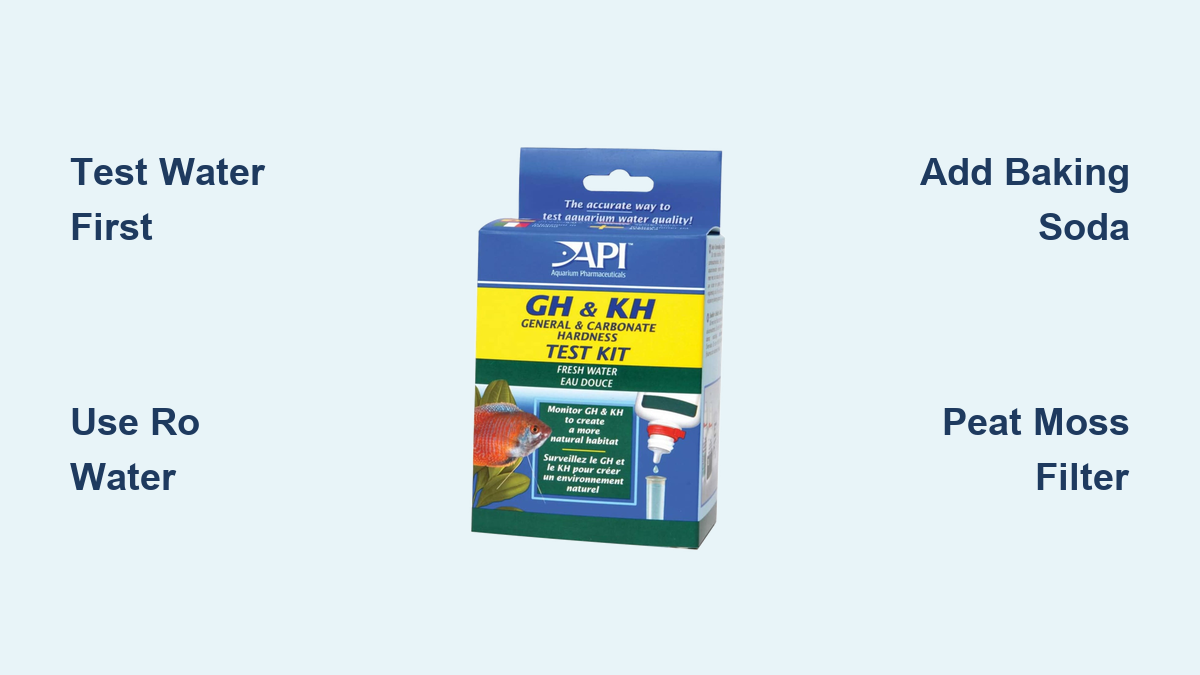
Accurate testing is non-negotiable when you need to fix GH and KH in your aquarium. Liquid test kits like API Freshwater Master Test Kit remain the gold standard over unreliable strips. Follow these steps for precision:
Why Your Test Results Lie (And How to Fix It)
Mistake #1: Testing immediately after water changes
Fresh tap water contains dissolved CO₂ that artificially lowers pH readings. Wait 24 hours after water changes for stable measurements. Test both your tap water and aquarium water simultaneously to identify contamination sources.
Mistake #2: Ignoring KH-pH relationship
Your KH value directly predicts pH stability. If KH is below 4 dKH, expect dangerous pH swings between morning and evening. Record both parameters together – a KH of 5 dKH should maintain pH around 7.2-7.6 in most freshwater tanks.
Mistake #3: Using expired reagents
Liquid test kits lose accuracy after 12 months. Check expiration dates and store bottles in a dark cabinet. For critical adjustments, cross-verify with a Hanna KH checker for $30.
3 Reliable Ways to Lower GH and KH for Soft-Water Fish
When your discus or cardinal tetras show stress signs in hard water, these methods safely soften your aquarium without toxic side effects. Never attempt rapid changes – reduce GH/KH by no more than 20 ppm per day.
Method 1: RO Water Blending (Most Effective)
Reverse osmosis (RO) units produce 0 GH/KH water that becomes your blank canvas. For a 55-gallon tank with 250 ppm GH tap water needing 100 ppm GH:
– Mix 60% RO water with 40% tap water
– Test resulting blend before adding to tank
– Use exclusively for water changes going forward
Pro Tip: Add Seachem Equilibrium at 1/4 dose to RO water for essential trace elements without raising hardness.
Method 2: Peat Moss Filtration (Natural & Gradual)
Boil sphagnum peat moss for 10 minutes, then add to a filter media bag:
– Place in high-flow area of canister filter
– Expect 10-15% GH/KH reduction over 2 weeks
– Monitor pH daily – stops working when pH hits 6.0
Warning: Causes tannin staining. Pair with activated carbon if discoloration bothers you.
Method 3: Indian Almond Leaves (Shrimp-Safe Solution)
For sensitive shrimp tanks requiring near-zero GH:
– Add 1 leaf per 10 gallons weekly
– Releases humic acids that bind calcium/magnesium
– Provides natural antibacterial benefits
Time Estimate: 3-4 weeks to see significant GH reduction in soft-water species tanks.
How to Raise GH and KH for Cichlids and Livebearers

Mollies gasping at the surface or African cichlids losing vibrant colors signal dangerously low KH. These methods rebuild mineral content safely for hard-water species without spiking pH uncontrollably.
Baking Soda Dosing (For Immediate KH Rescue)
When KH crashes below 3 dKH causing pH swings:
– Dissolve 1/2 teaspoon baking soda in 1 cup tank water
– Pour slowly into filter outflow
– Raises KH by 2 dKH per 20 gallons
Critical: Never use baking powder – the added acids will destabilize pH further. Test KH 2 hours after dosing.
Crushed Coral Substrate (Long-Term Stability)
For permanent KH/GH elevation in cichlid tanks:
– Replace 50% of substrate with aragonite sand
– Or fill media bag with crushed coral in filter
– Dissolves slowly to maintain 8-12 dKH
Pro Tip: Place coral in sump or high-flow area for faster dissolution during initial setup.
Magnesium Sulfate Boost (For GH-Only Deficiency)
If plants show yellowing between veins but KH is adequate:
– Dissolve 1 tablespoon Epsom salt per 20 gallons
– Raises GH by 10 ppm without affecting KH
– Apply during water changes only
Warning: Do not exceed 1 tsp per 10 gallons monthly – magnesium toxicity causes paralysis.
Step-by-Step: Adjusting GH and KH Without Shocking Your Tank
Follow this 5-day protocol when you need to fix GH and KH in your aquarium. Never change parameters by more than 20 ppm GH or 2 dKH daily.
Day 1: Baseline Assessment
Test current GH, KH, and pH. Research your species’ ideal range – discus need 1-4 dGH while guppies require 10-15 dGH. Calculate your target adjustment.
Day 2: Source Water Correction
For lowering: Blend RO/tap water to target hardness. For raising: Pre-dissolve minerals in replacement water. Always treat new water with conditioner first.
Day 3: First 25% Water Change
Replace tank water with your prepared blend. Test parameters immediately after and again in 12 hours. If changes exceed 10%, stop adjustments.
Days 4-5: Stabilization Phase
Add mineral buffers (like crushed coral bags) or softening media (peat) to filters. Re-test daily – parameters should stabilize within 48 hours of last water change.
Critical Safety Check: If fish show rapid gill movement or lethargy during adjustments, perform an emergency 20% water change with unmodified tank water immediately.
GH/KH Emergencies: Fixing pH Crashes and Mineral Spikes
When your pH plummets below 6.0 overnight or KH disappears completely, act within hours to save your tank.
Emergency pH Crash Protocol
- Perform 30% water change with pre-buffered water (add 1 tsp baking soda per 20 gallons)
- Place crushed coral directly in filter media tray
- Test KH hourly until stabilized above 4 dKH
- Add Seachem Alkaline Buffer if pH remains below 6.5 after 2 hours
Sudden GH Spike Response
If limestone decorations leach minerals:
1. Remove all calcareous rocks immediately
2. Do 50% water change with RO water
3. Add peat moss to filter to bind excess calcium
4. Vacuum substrate to remove dissolved mineral dust
Proven Prevention: Place all new rocks in a bucket of distilled water for 72 hours before tank introduction. If pH rises above 7.0, the rock is unsuitable for soft-water tanks.
Maintaining stable GH and KH isn’t about hitting perfect numbers – it’s about creating consistent conditions your fish evolved to survive in. Regular testing, source water awareness, and gradual adjustments transform water chemistry from a mystery into your most powerful fishkeeping tool. Always document changes in a logbook: note water change dates, parameter shifts, and fish behavior to predict problems before they escalate. For long-term success, match your fish species to your natural tap water whenever possible – it’s far easier to choose cichlids for hard water than to constantly fight your municipal supply. With these methods, you’ll fix GH and KH in your aquarium permanently, transforming stressed, hiding fish into vibrant, active residents within weeks.