20 Gallon Tall Aquarium Dimensions (2026 Guide)
That moment when you realize your new aquarium won’t fit through the doorway or your stand starts creaking under unexpected weight—it’s a nightmare every aquarist fears. For the popular 20-gallon tall tank (often called the “20-gallon high”), precise 20 gallon tall aquarium dimensions are your first line of defense against costly mistakes. Unlike its wider counterpart, this vertical aquarium demands special attention to measurements, weight distribution, and species compatibility. Understanding these exact specs isn’t just helpful—it’s critical for preventing structural failures and creating a thriving ecosystem. In this guide, you’ll discover the real-world implications of those numbers and exactly how to leverage this tank’s unique shape for stunning aquatic displays.
Choosing between aquarium sizes often feels overwhelming, but the 20-gallon tall stands out for its dramatic vertical potential. While it holds the same 20 gallons as the “long” version, its compressed footprint creates entirely different challenges and opportunities. Most beginners don’t realize that the 20 gallon tall dimensions directly impact everything from fish behavior to stand safety—factors that can make or break your aquatic experience. By the end of this guide, you’ll know exactly how to measure, support, and stock this tank for long-term success, avoiding the top pitfalls that sink new hobbyists.
Why Precise 20-Gallon Tall Measurements Prevent Costly Disasters
Getting the numbers wrong with a 20-gallon tall tank risks more than just an awkward fit—it can lead to catastrophic failure. Unlike standard furniture, aquariums exert immense pressure on small surface areas, making millimeter-level accuracy essential for safe placement. Always measure twice before committing to any stand or location, and never assume manufacturer dimensions match your space perfectly.
Exact External Dimensions: 24x12x16 Inches Decoded
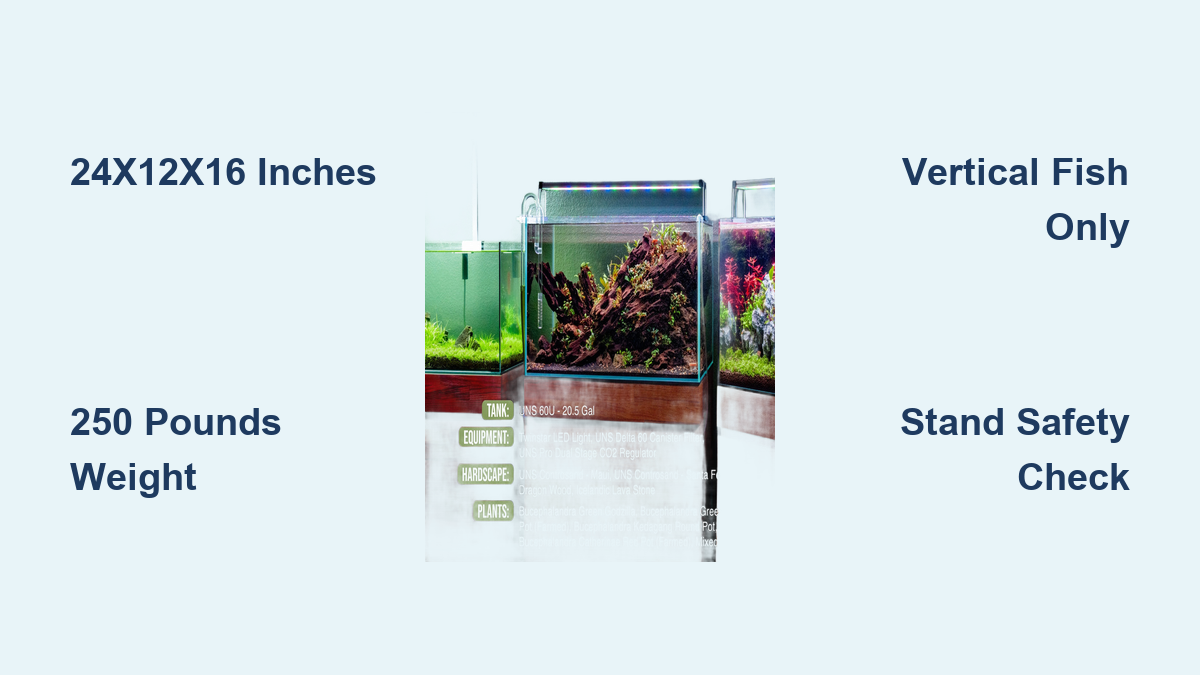
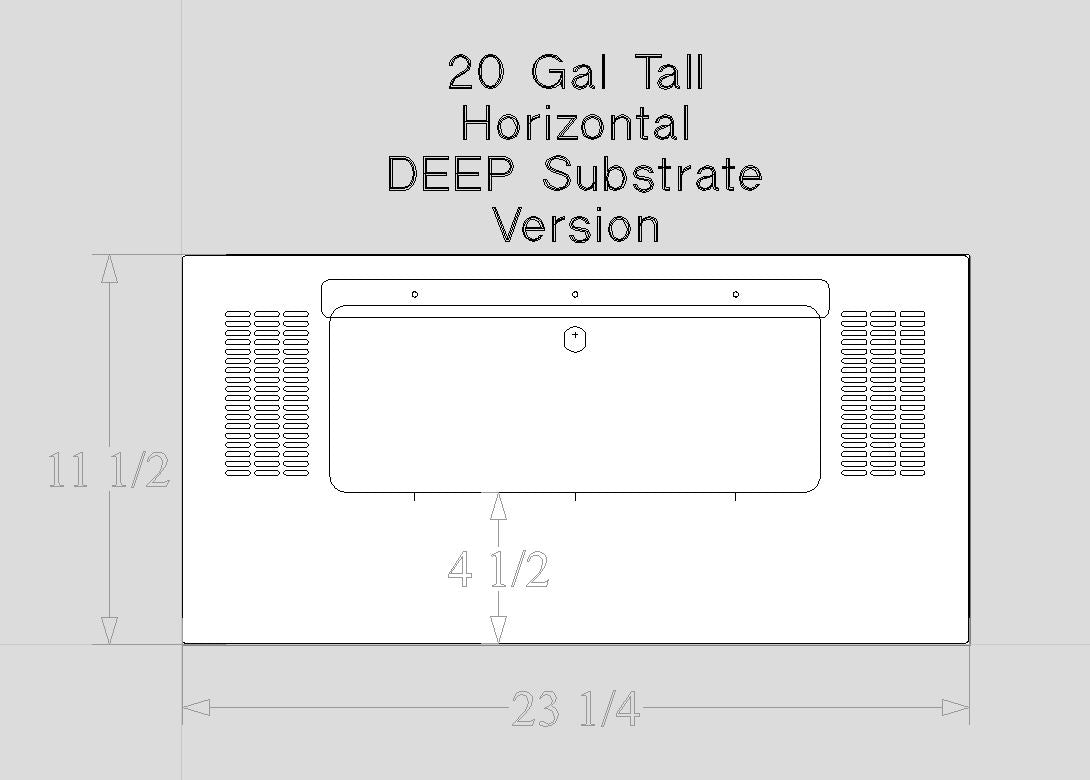
The standard 20 gallon tall aquarium dimensions are 24 inches long × 12 inches wide × 16 inches high for glass models. These external measurements determine your minimum clearance space—meaning you need at least 24.5 inches of length and 12.5 inches of width to accommodate the tank’s edges and any protective foam. Crucially, the 16-inch height includes the rim but excludes lids or lighting systems, which often add 2-3 extra inches. When positioning near walls or cabinets, remember to leave 2-inch service gaps on all sides for filter access and evaporation management.
Calculating True Footprint for Stand Compatibility
Your stand must perfectly match the tank’s 24″ × 12″ base footprint—no exceptions. Any overhang beyond 0.5 inches creates dangerous leverage points, while undersized stands concentrate pressure on unsupported glass seams. Pro tip: Place a level on the empty stand before setup. If it wobbles more than 1/8 inch across the surface, shims won’t save you—find a new stand. This tiny variance causes uneven weight distribution that stresses glass corners, the most common failure point in aquariums.
Displacement Reality: Why You’ll Never Have Exactly 20 Gallons
Despite the “20-gallon” label, actual water volume in a tall tank typically runs 17-18 gallons after accounting for substrate and decor. A standard 2-inch gravel layer consumes nearly 2 gallons of space, while driftwood or rock formations can reduce capacity by another 10%. Always calculate stocking levels based on actual water volume—overestimating leads to dangerous overcrowding. Use this quick formula: (L×W×H in inches ÷ 231) – 10% for displacement = true gallon capacity.
Critical Weight Thresholds That Determine Tank Safety
The crushing weight of a full 20-gallon tall tank surprises most first-time owners. This isn’t like moving a bookshelf—the concentrated load creates extreme pressure per square inch that ordinary furniture can’t handle. Ignoring these weight realities risks floor damage, structural failure, or worst of all, a catastrophic tank rupture that destroys your home.
Empty Tank Weight: Glass vs. Acrylic Showdown
An empty 20-gallon tall glass tank weighs 25-30 pounds—deceptively light until you lift it. Acrylic versions are 40% lighter (15-18 pounds) but scratch more easily. Critical visual cue: Check for hairline cracks along bottom seams before filling. Tap the glass lightly; a hollow “ping” indicates integrity, while a dull “thud” suggests microfractures. Never use a tank showing either sign—it will fail under load.
Water Weight Calculation: The 167-Pound Minimum
Freshwater weighs 8.34 pounds per gallon, meaning 20 gallons equals 166.8 pounds of pure water. But factor in substrate displacement, and you’re still looking at 150+ pounds of liquid alone. Saltwater adds 10% more weight—183 pounds for the same volume. This isn’t theoretical: when combined with the tank’s weight, you’re already at 180 pounds before adding a single rock or plant.
Total Setup Weight: Why 250 Pounds is the Real Number
A fully cycled 20-gallon tall aquarium hits 225-250 pounds with standard setup:
– Tank: 28 lbs
– Water: 167 lbs
– 40 lbs substrate: 45 lbs (wet weight)
– Decor/filter: 15 lbs
– Lid/lighting: 10 lbs
This massive weight concentrates on just 288 square inches of surface area—generating over 0.8 PSI pressure. For perspective, that’s heavier per square inch than most grand pianos. Common mistake: Placing tanks on carpeted floors. The padding creates micro-sagging that unevenly distributes weight—always use a plywood underlayment on soft surfaces.
20-Gallon Tall vs. Long: Choosing Your Battle for Fish Happiness

Both tanks hold 20 gallons, but their shapes create fundamentally different ecosystems. The tall tank’s vertical design isn’t just aesthetic—it directly impacts fish physiology and behavior. Choosing wrong leads to stressed, unhealthy fish regardless of water quality. This isn’t about preference; it’s about matching tank geometry to biological needs.
Vertical Swimmers vs. Horizontal Cruisers: A Survival Guide
Angelfish and hatchetfish thrive in tall tanks because they evolved in Amazonian floodplains with deep, narrow channels. Their torpedo-shaped bodies are built for vertical darting—not endless horizontal laps. Conversely, zebra danios and corydoras become stressed in tall tanks; they need long sightlines to feel secure. Red flag: If fish constantly hover near the surface or hide in corners, your tank shape likely mismatches their instincts.
Surface Area Science: Oxygen Exchange You Can’t Ignore
The 20-gallon long’s 30″x12″ footprint provides 360 square inches of surface area versus the tall’s 288 square inches—a 20% oxygen exchange advantage. This matters critically for heavily stocked tanks or warm-water species. In a tall tank, you’ll need stronger surface agitation to compensate. Watch for gasping at the surface—that’s your cue to upgrade aeration immediately.
Aquascaping Strategy: Leveraging Height for Visual Impact
Tall tanks excel with “cathedral” aquascapes featuring central driftwood spires or stacked rock columns that draw the eye upward. Use vallisneria or hornwort in back corners to create depth illusions. Avoid spreading decor horizontally—it makes the tank feel cramped. Pro tip: Place your brightest light source at the top third of the tank to highlight vertical elements, not the substrate.
Stand Selection: The Non-Negotiable Safety Checklist
Your stand isn’t furniture—it’s critical structural support. A failed stand destroys years of aquascaping work in seconds. The 250-pound reality of a full 20-gallon tall demands engineering-grade solutions, not IKEA hacks. This is where most hobbyists cut dangerous corners.
Weight Capacity: Why 300 Pounds is the Absolute Minimum
Always choose stands rated for 50% more than your tank’s maximum weight. For a 250-pound setup, that means 375 pounds capacity. Most pet store stands meet this, but third-party furniture rarely does. Test before buying: Stand on the platform with a full backpack—any flex or creak means reject it immediately. Metal-framed stands outperform wood for tall tanks due to superior vertical load distribution.
Leveling Protocol: The 1/16-Inch Tolerance Rule
Use a precision level during setup—no “close enough” measurements. If the stand slopes more than 1/16 inch across its surface, water pressure will gradually bow the glass over months. Place shims under all four corners simultaneously; single-corner adjustments create dangerous stress points. Recheck leveling monthly as floors settle.
Furniture Danger Zone: Why Bookshelves Fail Spectacularly
Standard bookshelves lack cross-bracing to handle concentrated aquarium loads. Within 6-12 months, shelves often warp downward in the center, creating a “bow” that cracks tank seams. The horror stories are real: one aquarist lost $500 of livestock when a repurposed cabinet buckled during a routine water change. Invest in a true aquarium stand—it’s cheaper than replacing your living room.
Strategic Stocking: Maximizing Your Tall Tank’s Potential
The narrow width of a 20-gallon tall (just 12 inches) creates unique stocking challenges. Forget generic “one inch per gallon” rules—here, swimming patterns and territory needs dictate success. Stock incorrectly, and even pristine water parameters won’t prevent aggression or stress.
Top Species for Vertical Zones: Beyond Angelfish
While angelfish are classic tall-tank residents, consider these underrated options:
– Dwarf gouramis: Use labyrinth organs to breathe at surface in deeper water
– Cardinal tetras: School vertically in dense plant thickets
– Kuhli loaches: Burrow vertically in sand substrates
– Bamboo shrimp: Filter-feed effectively in taller water columns
Avoid: Corydoras (need wide foraging space), rainbowfish (require long swimming lanes), or any fish over 4 inches long.
Plant Selection: Growing Up Instead of Out
Prioritize plants with vertical growth habits:
– Background: Vallisneria spiralis (reaches 20+ inches)
– Midground: Rotala indica (grows 10-12 inches tall)
– Foreground: Dwarf hairgrass (stays low but spreads minimally)
Avoid carpeting plants—they get lost in the depth. Trim stem plants weekly to prevent light blockage at lower levels.
Territory Mapping: Preventing Aggression in Confined Spaces
In narrow tanks, visual barriers are critical. Use tall driftwood or rock stacks to create “rooms” that break line-of-sight. For cichlids like rams, provide one cave per fish at opposite corners. Warning sign: Rapid color fading indicates stress from insufficient territory—rearrange hardscape immediately.
Equipment Tweaks: Optimizing for Height Challenges
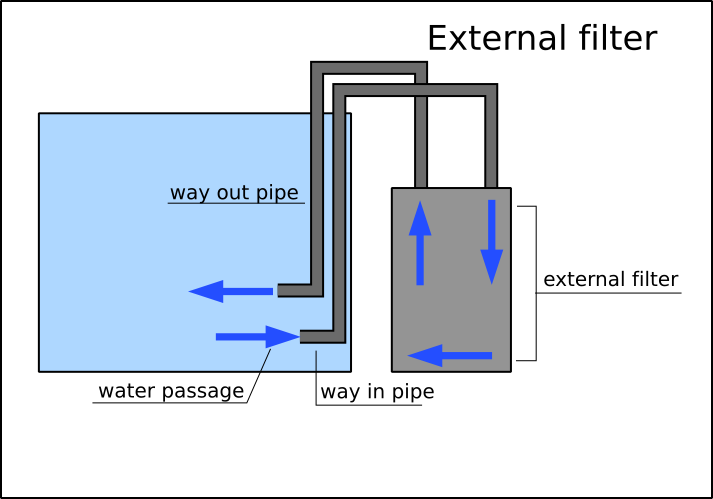
Standard equipment setups fail in tall tanks. The extra water column creates unique filtration, heating, and lighting demands that require specific adjustments. Skip these tweaks, and you’ll battle cloudy water, temperature layers, and dead plant zones.
Filter Positioning: Solving the Dead Zone Problem
Hang-on-back filters often create surface-only flow in tall tanks. Mount spray bars diagonally across the back glass to push current downward. For canister filters, position intake tubes near the substrate and outputs at mid-height to eliminate stagnant bottom zones. Pro hack: Add an air stone near the base to lift detritus into the filter’s path.
Heating Strategy: Eliminating Temperature Stratification
Without intervention, tall tanks develop 4-5°F temperature differences between top and bottom. Place heaters horizontally near the mid-point (8 inches up) rather than vertically at the base. Pair with a small powerhead to circulate warm surface water downward. Always use two thermometers—one at top, one at bottom—to verify uniform temps.
Lighting Adjustments: Reaching the Substrate Layer
Standard hoods leave the bottom 4-6 inches too dim for plant growth. Raise LED fixtures 2-3 inches above the tank or use pendant lights. For demanding plants like dwarf swords, supplement with a narrow-spectrum grow light aimed at the substrate. Critical: Run lights 1-2 hours longer than in long tanks to compensate for depth-related light loss.
The 20-gallon tall aquarium shines when you work with its vertical design rather than against it. By respecting the exact 20 gallon tall aquarium dimensions and their real-world implications—from that critical 24x12x16 footprint to the crushing 250-pound reality—you transform potential pitfalls into stunning visual advantages. Remember: success hinges on matching fish to vertical space, selecting a stand engineered for extreme loads, and tweaking equipment for height challenges. When done right, this tank creates breathtaking underwater skyscapes impossible in wider models. Measure meticulously, support relentlessly, and stock strategically—your thriving vertical ecosystem awaits.