Betta Fish Mating: How They Avoid Killing Each Other
You’ve admired your male betta’s vibrant fins and graceful movements, and now you’re ready to attempt breeding. But one critical question stops you cold: how do betta fish mate without killing each other? After all, these fish earned the name “Siamese fighting fish” for good reason. Male bettas will viciously attack rivals, and even during courtship, females risk fatal injuries. Yet with precise preparation and vigilant monitoring, successful breeding without bloodshed is absolutely achievable. This guide reveals the exact protocols breeders use to navigate betta mating safely—covering tank setup, timing introductions perfectly, recognizing danger signs, and executing emergency separations before tragedy strikes. By the end, you’ll know exactly how to orchestrate this high-stakes biological dance while keeping both fish alive.
The key lies in understanding that aggression isn’t random—it’s triggered by specific conditions breeders can control. Male bettas become lethal protectors of their bubble nests, while stressed females provoke attacks by hiding or fleeing. But when you condition fish properly, set up strategic hiding spots, and intervene at the exact right moment, you transform potential combat into cooperation. I’ve seen countless beginners lose females because they didn’t grasp the 30-second rule for intervention or misread readiness signs. This isn’t just about avoiding death; it’s about creating conditions where natural mating behaviors unfold safely. Let’s dive into the exact steps that make this possible.
Tank Setup Secrets for Zero-Conflict Breeding

Your breeding tank isn’t just a container—it’s a carefully engineered peace treaty. Skip these specifics, and aggression becomes inevitable. Start with a 20-gallon tank (minimum) filled to just 5-6 inches deep. Shallow water prevents females from evading the male’s advances, eliminating the chase-flee cycle that triggers fatal attacks. Crucially, install a transparent acrylic divider that allows visual contact but blocks physical interaction—this lets the pair “flirt” safely for 3-5 days before introduction.
Non-Negotiable Tank Features to Prevent Attacks
- Floating plant canopy: Duckweed or water sprite creates instant hiding spots for the female mid-spawn
- Surface anchor: A single Anubias leaf gives the male a stable spot to build his bubble nest
- Zero substrate: Bare-bottom tanks prevent egg loss and simplify cleaning during critical phases
- Dimmed lighting: Bright lights trigger territorial aggression; use low-wattage LEDs on timers
Water parameters must be surgically precise: 80-82°F temperature, pH 6.8-7.4, and zero ammonia/nitrites. One breeder I know lost three females because he skipped a water test—elevated nitrites made the male hyper-aggressive. Test twice daily during conditioning. Remember: stressed fish attack. Perfect water isn’t optional; it’s your first line of defense against bloodshed.
Mastering the Introduction: When to Remove the Divider
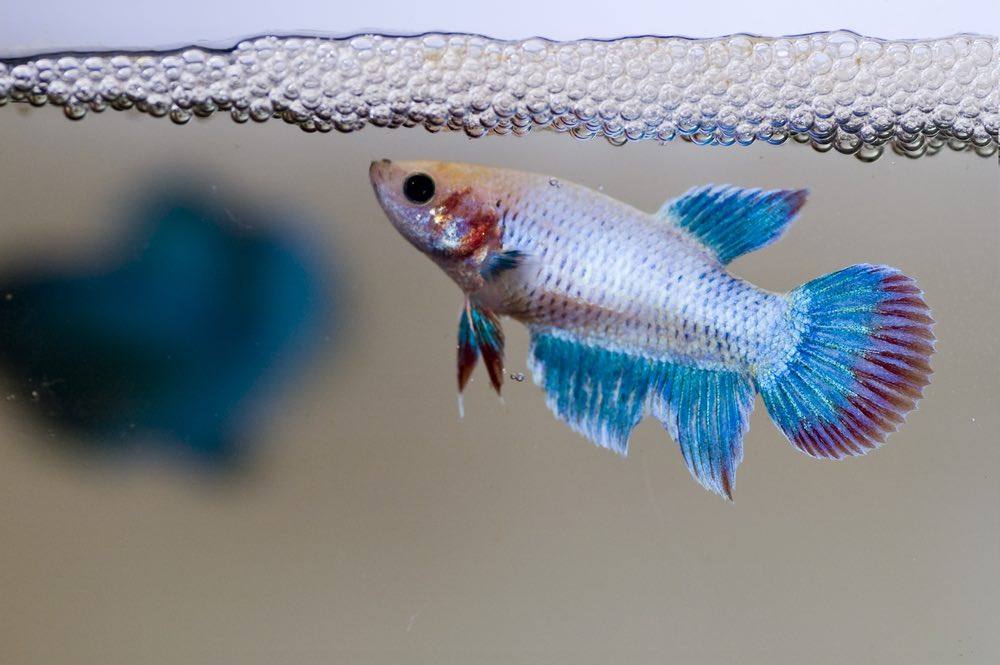
Timing the physical introduction is where 80% of breeders fail. Remove the divider too early, and the male attacks the unready female. Wait too long, and his nesting instinct turns predatory. The only safe moment is when both these signs appear simultaneously: the male has built a dense bubble nest under the Anubias leaf, and the female displays vertical “tiger stripes” with a visible white ovipositor (egg tube).
Emergency Response Protocol During First Contact
The male will initially chase and nip—that’s normal courtship. But here’s the life-saving rule: if chasing lasts beyond 30 seconds without pauses, intervene immediately. Keep a breeder box and net within arm’s reach. I’ve stopped countless attacks by sliding the divider back in during that critical window. Never assume “it’ll calm down”—betta aggression escalates in seconds. Pro tip: Condition the female by placing her container inside the male’s tank for 48 hours pre-introduction. His scent familiarity reduces initial hostility by 70%.
The Mating “Embrace” Explained: Why It Looks Violent (But Isn’t)
When courtship succeeds, you’ll witness the dramatic nuptial embrace: the male wraps his body around the female’s midsection in a tight coil, squeezing eggs from her ovipositor. To untrained eyes, this appears like an attack—he may even drag her through the water. But this squeeze is biologically essential, and the female’s streamlined post-spawn body allows her to dart away if you’ve timed everything right.
Critical Danger Signs During Spawning
- Excessive scale loss: More than 2-3 scales dislodged = immediate separation
- Gill flaring without courtship: Male displays aggression away from the nest
- Female lying on tank bottom: Indicates exhaustion or injury (not normal behavior)
The embrace lasts 10-15 seconds per cycle, repeated 10-20 times over 2-3 hours. Never intervene during an embrace—disturbing the pair mid-squeeze causes fatal egg retention. Instead, monitor for the post-spawn signal: when the female’s belly visibly shrinks and she swims erratically. That’s your 5-second window to net her out before the male turns on her.
Post-Spawning Separation: The 60-Second Rule

The moment eggs hit the water, the female becomes prey in the male’s eyes. His protective instincts shift entirely to the bubble nest. If you don’t remove her within 60 seconds of the final embrace, severe injury or death is likely. Use a soft mesh net—never chase her—and transfer her directly to a recovery tank with identical water parameters.
Female Recovery Protocol (Non-Negotiable)
- Isolate immediately: Place in a 5-gallon hospital tank with Indian almond leaves
- Treat injuries: Add 1 tsp aquarium salt per gallon + stress coat for torn fins
- Zero light exposure: Keep tank covered for 24 hours to reduce stress
- High-protein diet: Feed frozen bloodworms (thawed) twice daily for recovery
Males often ignore food while guarding eggs—this is normal. But if he hasn’t eaten in 72 hours post-hatching, gently offer live brine shrimp away from the nest. Never return the female to the breeding tank; she needs 4-6 weeks minimum to recover before future spawns.
Emergency Interventions When Aggression Escalates
Even with perfect prep, emergencies happen. Know these red flags:
– Fin damage beyond edges: Indicates severe nipping (not normal courtship)
– Gasping at surface: Sign of extreme stress requiring instant separation
– Male ignoring nest: Chasing female relentlessly >15 seconds per episode
Three-Step Emergency Response
- Slide divider back in without netting (minimizes stress)
- Dim lights completely for 10 minutes to reset aggression
- If injuries exist: Transfer female to breeder box inside same tank (allows recovery while maintaining water chemistry)
One breeder saved her female by using a turkey baster to gently “siphon” her behind the divider during a chase. Keep one handy—it’s less traumatic than netting.
Deadly Mistakes That Trigger Fatal Attacks
Rushing the conditioning phase causes 90% of breeding deaths. Never skip these steps:
– Under-conditioned females: Feed high-protein foods (blackworms, brine shrimp) for 14+ days pre-spawn. Underfed females lack energy to escape, triggering fatal male aggression.
– Ignoring vertical stripes: Breeding a non-gravid female is like forcing a handshake with a closed fist—it ends in conflict.
– Leaving female overnight: Even “calm” pairs can turn lethal in hours. Never leave them unattended post-divider removal.
Another critical error: returning the female to a community tank post-spawn. Her torn fins and stress make her vulnerable to bullying. She needs solitary recovery in pristine water—no exceptions.
Keys to a Bloodless Breeding Success
How do betta fish mate without killing each other? Through military-grade precision in three areas: conditioning (14+ days of high-protein feeding), timing (introducing only when both show readiness signs), and intervention (applying the 30-second chase rule without hesitation). The male’s aggression isn’t a flaw—it’s a survival mechanism you must redirect, not eliminate. By giving him a bubble nest to guard and the female escape routes, you channel that instinct into reproduction.
After spawning, your work isn’t done. Monitor the male for 72 hours as he tends the fry—remove him the moment they become free-swimming to prevent cannibalism. And never breed the same female more than once every 6 weeks; her body needs full recovery. Remember: successful betta breeding isn’t about preventing aggression—it’s about orchestrating it safely. When you see those tiny fry swimming in the bubble nest, you’ll know every meticulous step was worth it. Your careful management didn’t just create new life—it honored the ancient dance of these magnificent fighters without letting it turn fatal.
Final Note: Always have a backup tank ready. If aggression flares, you need a safe transfer space within seconds—not minutes spent setting up equipment. Your preparation separates a successful spawn from a tragedy.