Aquarium Fish Temperature Guide: Ideal Tank Temperatures
That moment when you notice your usually active betta suddenly lethargic in the corner of the tank—chances are temperature imbalance is to blame. Water temperature isn’t just a number on your heater display; it’s the invisible lifeline determining whether your aquatic community thrives or barely survives. Just a 2-3 degree variance outside their ideal range can suppress immune systems, trigger disease outbreaks, and shorten lifespans. This aquarium fish temperature chart delivers precise thermal requirements for common species so you can create a stable environment where your fish display vibrant colors, natural behaviors, and optimal health.
Most beginners don’t realize that temperature directly controls fish metabolism—warmer water speeds up biological processes while cooler water slows them down. When your angelfish stop eating or your neon tetras develop fin rot, check your thermometer before reaching for medication. By the end of this guide, you’ll know exactly where to set your heater for each species in your tank, how to prevent deadly temperature swings, and proven fixes when things go wrong.
Why Temperature Stability Matters More Than Perfect Numbers
Fish don’t experience temperature as a fixed number but as a constant environmental condition their bodies have adapted to over generations. A tank fluctuating between 75-80°F stresses fish more than a steady 77°F—even if 77°F isn’t ideal for your species. This constant adjustment depletes energy reserves needed for immune function and growth. When your discus stop eating or your guppies develop white spot disease, check your temperature stability before diagnosing other issues.
How Temperature Affects Critical Biological Functions
- Metabolism: For every 10°F increase, tropical fish metabolism roughly doubles—meaning they eat more but age faster
- Oxygen levels: Warm water holds less dissolved oxygen, creating suffocation risk for active swimmers like zebra danios
- Ammonia toxicity: Temperature directly impacts how toxic ammonia becomes—warmer water makes existing ammonia 5x more lethal
- Breeding triggers: Many species like kribensis require precise 2-3°F temperature drops to initiate spawning
Pro Tip: Place your thermometer opposite the heater outlet to measure true tank-wide temperature rather than localized “hot spots” near the heating element.
Critical Temperature Zones for 20 Popular Freshwater Fish
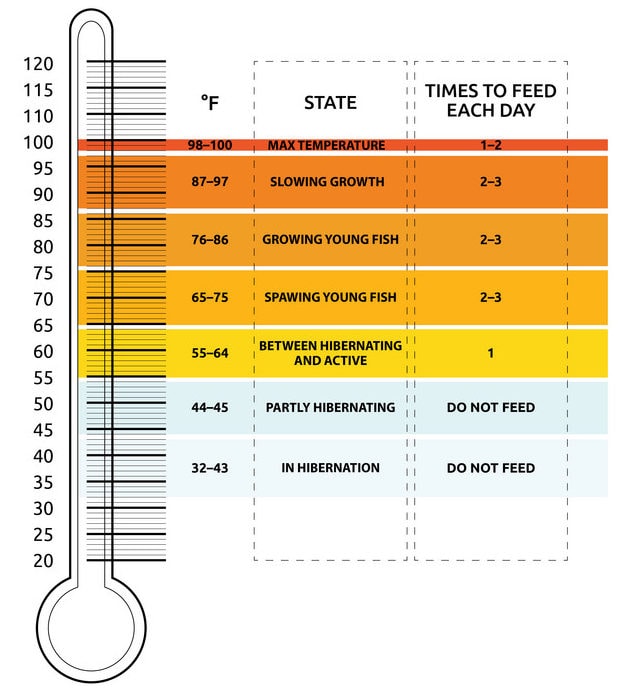
Your aquarium fish temperature chart must account for species-specific needs—mixing incompatible thermal requirements is a common beginner mistake. These ranges represent the sweet spot where each species shows best coloration, feeding response, and disease resistance.
Tropical Fish Requiring Warm Water (78-86°F)
Betta splendens thrive at 78-80°F—any cooler and their immune system weakens dramatically. These labyrinth fish survive brief temperature drops but never flourish below 76°F.
Discus demand precision at 82-86°F with zero fluctuations. Even a 2°F drop during water changes can trigger fatal infections in these sensitive cichlids.
German Blue Rams need 78-85°F with stable conditions—combine this with soft, acidic water for their stunning electric blue coloration.
Mid-Range Temperature Species (72-79°F)
Neon tetras actually prefer 75-77°F rather than the commonly cited 72-81°F range—this middle zone prevents their signature blue stripe from fading.
Angelfish require 78-84°F for breeding but tolerate 75-86°F for maintenance—watch for bent spines if kept below 75°F long-term.
Corydoras catfish need consistent 72-78°F—sudden drops below 70°F cause their sensitive barbels to deteriorate.
Coldwater and Versatile Species (65-77°F)
Zebra danios thrive across 65-77°F but show brightest colors at 72-75°F—avoid pushing them to 77°F as this shortens their lifespan.
Goldfish need 68-74°F—keeping them warmer than 74°F accelerates growth but causes organ strain and shortened lifespans.
White Cloud Mountain Minnows are true coldwater fish that prefer 64-72°F—never mix with tropical species despite their similar appearance to danios.
Warning: Mixing goldfish (coldwater) with tropical fish like guppies in the same tank is a common mistake that stresses both species—stick to compatible thermal requirements.
Precision Heater Setup: Avoiding Costly Temperature Mistakes

Your heater wattage directly determines how effectively your aquarium maintains temperature stability—especially during seasonal changes. For a standard 20-gallon tank in a 72°F room, you need exactly 100 watts (5 watts per gallon). Basement tanks in cooler rooms require 7-8 watts per gallon to prevent heater burnout.
Step-by-Step Heater Installation for Perfect Temperature Control
- Calculate proper wattage: Multiply tank gallons by 5 (e.g., 30-gallon tank = 150W heater)
- Position horizontally: Place near filter outlet for even heat distribution—never stand vertically
- Install heater guard: Essential for cichlids, oscars, or any large fish that might bump the glass
- Calibrate with secondary thermometer: Submersible glass thermometers beat stick-on varieties by 2-3°F accuracy
- Test before adding fish: Run heater 24 hours with thermometer to confirm stability
Pro Tip: Use two smaller heaters instead of one large unit—this provides redundancy if one fails and creates more even heat distribution.
Emergency Fixes for Temperature Disasters (Without Killing Your Fish)
When your heater fails overnight or summer heat spikes your tank to 88°F, you need immediate solutions that won’t shock your fish. Never drop frozen water bottles directly into the tank—this creates dangerous micro-climates fish can swim into.
Cooling an Overheated Tank Safely
- Clip-on fan method: Position a small fan blowing across water surface—lowers temperature 2-4°F per hour through evaporation
- Gradual water exchange: Replace 20% of tank water with pre-cooled water (match current temperature exactly)
- Frozen bottle technique: Float sealed bottle of frozen water outside the tank with tubing running through it—never direct contact
Warming a Dangerously Cold Tank
- Hot water bottle: Fill clean bottle with 100°F water, float in tank (monitor closely to avoid overheating)
- External heater: Place submersible heater in bucket of tank water, then slowly add to aquarium
- Room temperature fix: Turn up house thermostat gradually—never use space heaters near aquariums
Critical Warning: Never change water temperature more than 2°F per hour—rapid shifts cause fatal osmotic shock even if moving toward ideal range.
Seasonal Temperature Strategies That Actually Work

Summer heat waves and winter cold snaps create unique challenges your standard heater can’t handle alone. Tropical tanks in warm climates face overheating risks even with proper equipment—especially during power outages when heaters stay off but room temperatures soar.
Summer Survival Tactics
- Nighttime cooling: Run fans only at night when ambient temperatures drop
- Insulated tank covers: Use egg crate lighting hoods that allow evaporation while blocking heat
- Strategic placement: Move tanks away from south-facing windows that create greenhouse effects
Winter Protection Protocol
- Tank insulation: Apply foam board to back and sides (never front)
- Heater redundancy: Install two heaters on separate power strips
- Room monitoring: Keep tank rooms above 65°F—even tropical tanks suffer when ambient air drops too low
Pro Tip: For outdoor ponds, use floating de-icers rather than submersible heaters in winter—this maintains a gas exchange hole without warming the entire water column.
Your Temperature Troubleshooting Checklist
When fish show stress signs, run through this temperature-focused diagnostic before treating symptoms:
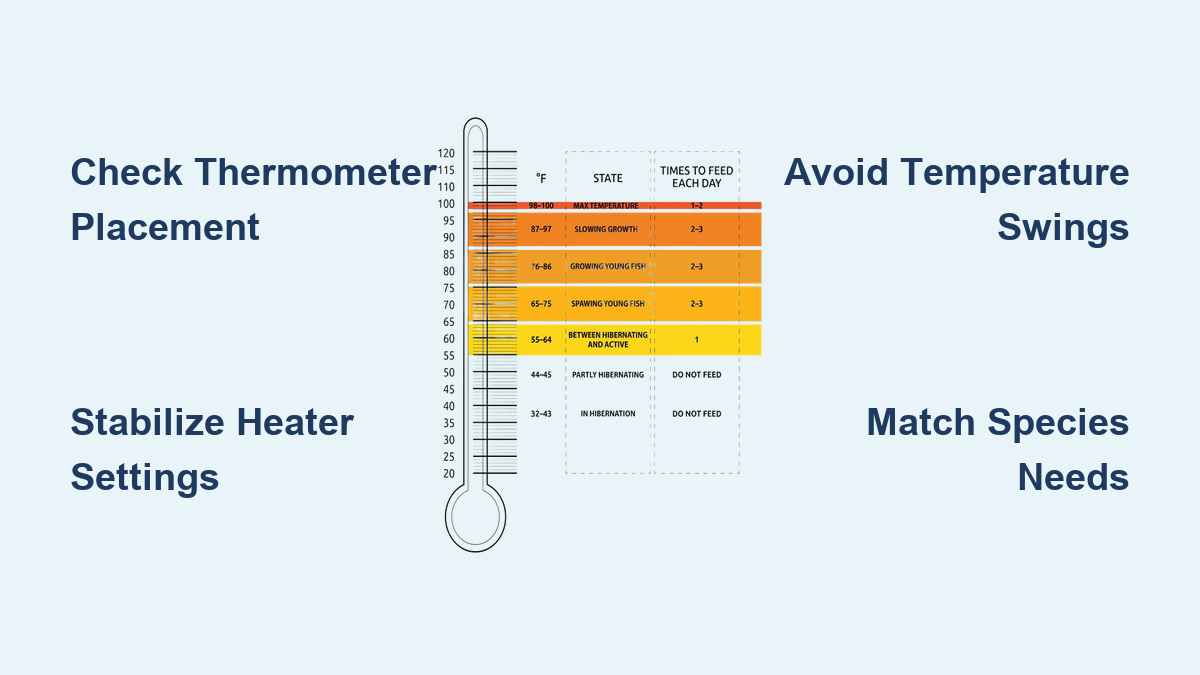
- Check thermometer placement: Is it near heater outlet showing falsely high reading?
- Test heater function: Feel for warmth (unplugged!) or use multimeter for continuity
- Verify seasonal impact: Has room temperature changed more than 5°F recently?
- Assess water movement: Poor circulation creates dangerous temperature gradients
- Review recent changes: Did water changes introduce significantly warmer/cooler water?
Final Tip: Program weekly temperature checks into your maintenance routine—write readings in a log to spot gradual heater drift before it becomes critical. A stable environment based on your aquarium fish temperature chart prevents 80% of common fish health issues before they start.